mongoBackend library
- Introduction
- Request processing modules
mongoUpdateContext(SR) andmongoNotifyContext(SR)mongoQueryContext(SR)mongoQueryTypes(SR and SR2)mongoCreateSubscription(SR2)mongoUpdateSubscription(SR2)mongoGetSubscriptions(SR2)mongoUnsubscribeContext(SR and SR2)mongoSubscribeContext(SR)mongoUpdateContextSubscription(SR)mongoRegisterContext(SR)mongoDiscoverContextAvailability(SR)mongoRegistrationGet(SR2)mongoRegistrationCreate(SR2)
- Low-level modules related to DB interaction
- Specific purpose modules
- The
MongoGlobalmodule
Introduction
The mongoBackend library is where all the database interaction takes place. More than that, it is where most of the actual processing for the different operations exposed by Orion Context Broker takes place. In some sense it is like the "brain" of Orion.
The entry points of this library are:
- From serviceRoutines and serviceRoutinesV2. Those are the most important entry points.
- Other entry points from other places as initialization routines and helpers methods.
This library makes an extensive use of mongoDriver library for sending operations to database and dealing with BSON data (which is the basic structure datatype used by these operations).
This library is also related to the cache library (if subscription cache is enabled, i.e. the global noCache bool variable is set to false), in two different ways:
- context creation/modificacion/removal modules modifying the subscription cache content
- entity creation/update logic checking the subscription cache in order to look for triggering subscriptions
Note that the subscription cache only applies to context subscriptions. The context availability subscriptions don't use any cache at all.
The different modules included in this library are analyzed in the following sections.
Request processing modules
These modules implement the different Context Broker requests. They are called during the overall request processing flow by service routine libraries (either the serviceRoutines or the serviceRoutinesV2 libraries). Nextcoming subsections describe each module (SR means the module is called from serviceRoutines and SR2 means the module is called from serviceRoutineV2; note that no module is called from both libraries).
This section also describes the MongoCommonRegister and MongoCommonUpdate modules which provide common functionality highly coupled with several other request processing modules. In particular:
MongoCommonRegisterprovides common functionality for themongoRegisterContextmodules.MongoCommonUpdateprovides common functionality for themongoUpdateContextandmongoNotifyContextmodules.
mongoUpdateContext (SR) and mongoNotifyContext (SR)
The mongoUpdateContext module provides the entry point for the update context operation processing logic (by means of mongoUpdateContext() defined in its header file lib/mongoBackend/mongoUpdateContext.h) while the mongoNotifyContext module provides the entry point for the context notification processing logic (by means of mongoNotifyContext() defined in its header file lib/mongoBackend/mongoNotifyContext.h). However, given that a context notification is processed in the same way as an update context of "APPEND" action type, both mongoUpdateContext() and mongoNotifyContext() are in the end basically wrapper functions for processContextElement() (single external function in the MongoCommonUpdate module), which does the real work.
The execution flow in this module depends on a few conditions which, for the sake of clarity, are describe based on five different subcases:
- Case 1: action type is "UPDATE" or "REPLACE" and the entity is found.
- Case 2: action type is "UPDATE" or "REPLACE" and the entity is not found.
- Case 3: action type is "APPEND" or "APPEND_STRICT" and the entity is found.
- Case 4: action type is "APPEND" or "APPEND_STRICT" and the entity is not found.
- Case 5: action type is "DELETE" to partially delete some attributes of an entity.
- Case 6: action type is "DELETE" to remove an entity.
Note that mongoUpdateContext() applies to all 6 cases, while mongoNotifyContext() only applies to cases 3 and 4.
Case 1: action type is "UPDATE" or "REPLACE" and the entity is found.
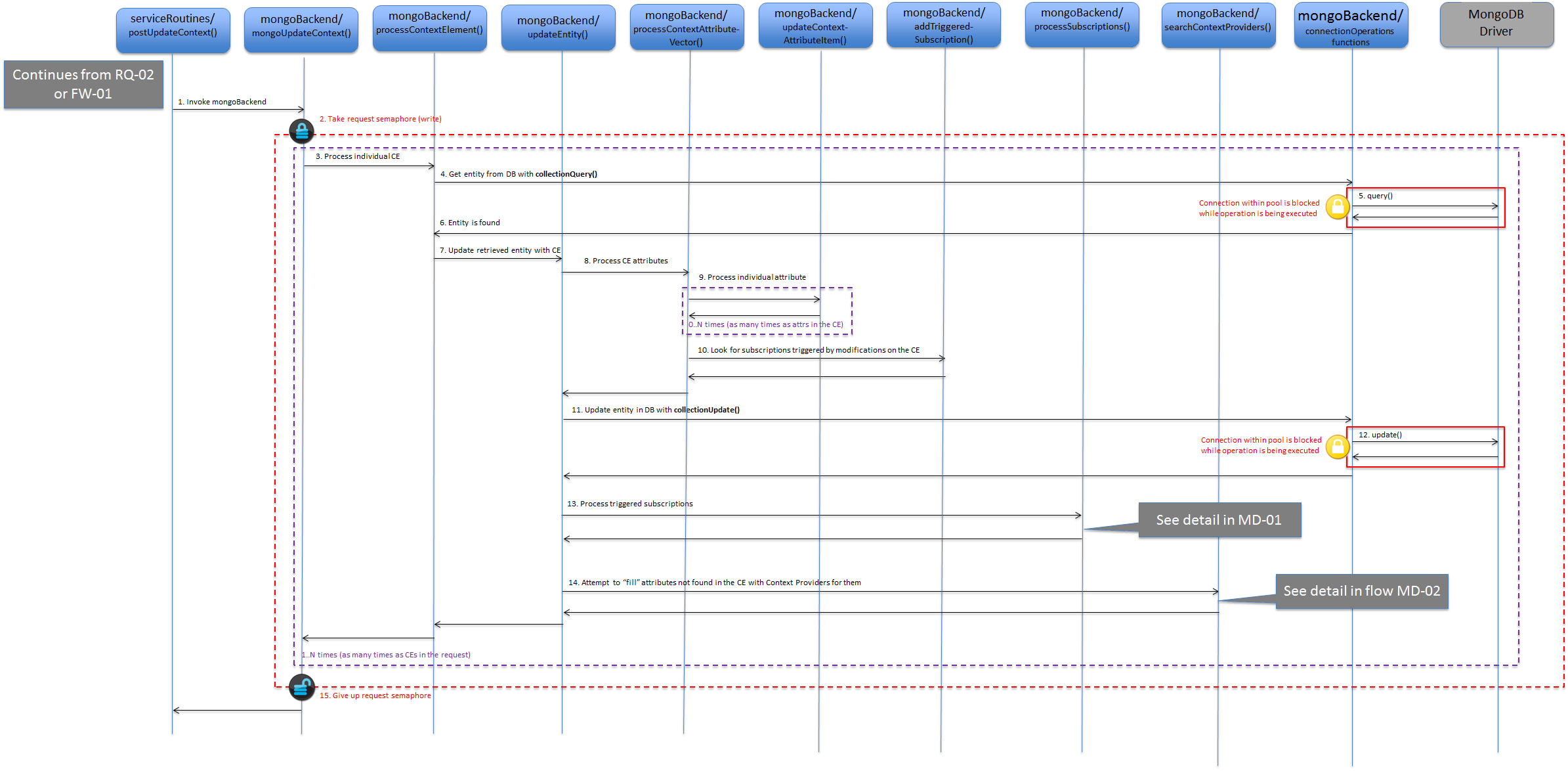
MB-01: mongoUpdate UPDATE/REPLACE case with entity found
mongoUpdateContext()is invoked from a service routine (step 1).- Depending on
-reqMutexPolicy, the request semaphore may be taken (write mode) (step 2). See this document for details. - In a loop,
processContextElement()is called for eachEntityobject of the incoming request (step 3). - After pre-conditions checks,
processContextElement()processes an individual entity. First, the entity corresponding to that Entity is searched in the database, usingcollectionQuery()in theconnectionOperationsmodule (steps 4 and 5). Let's assume that the entity is found (step 6). - The execution flow passes to
updateEntity(), in charge of doing the entity update (step 7).updateEntity()in sequence passes the flow toprocessContextAttributeVector()in order to process the attributes in the Entity (step 8). processContextAttributeVector()contains a loop callingupdateContextAttributeItem()for processing of each individual attribute in the Entity (step 9). Details on the strategy used to implement this processing later.- Once the processing of the attributes in done,
processContextAttributeVector()callsaddTriggeredSubscriptions()to detect subscriptions triggered by the update operation (step 10). More details on this later. - Finally the control is returned to
updateEntity()with invokescollectionUpdate()in theconnectionOperationsmodule in order to actually update the entity in the database (steps 11 and 12). - The next step is to send the notifications triggered by the update operation, which is done by
processSubscriptions()(step 13). More details on this in (diagram MD-01). - Finally,
searchContextProviders()is called to try to find a suitable context provider for each attribute in the Entity that was not found in the database (step 14). This information would be used by the calling service routine in order to forward the update operation to context providers, as described in the context providers documentation. More information onsearchContextProviders()in (diagram MD-02). - If the request semaphore was taken in step 2, then it is released before returning (step 15).
Case 2: action type is "UPDATE" or "REPLACE" and the entity is not found.
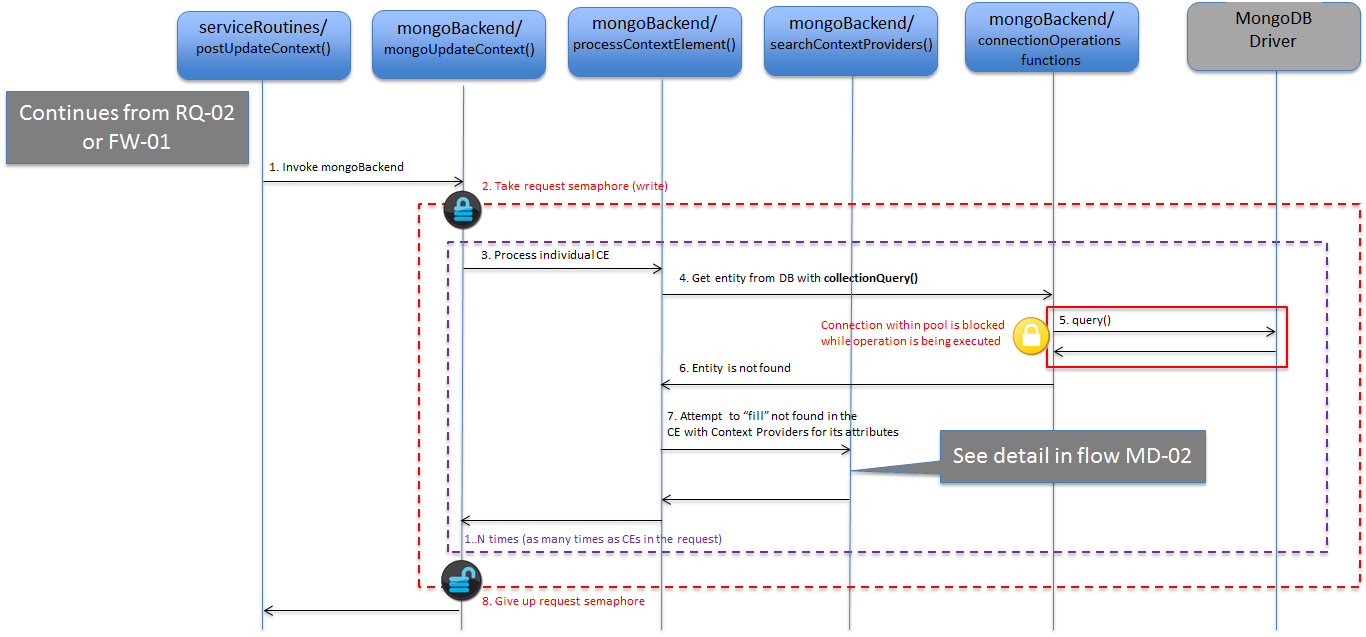
MB-02: mongoUpdate UPDATE/REPLACE case with entity not found
mongoUpdateContext()is invoked from a service routine (step 1).- Depending on
-reqMutexPolicy, request semaphore may be taken (write mode) (step 2). See this document for details. - In a loop,
processContextElement()is called for eachEntityobject (Entity, in short) of the incoming request (step 3). - After precondition checks,
processContextElement()processes an individual Entity. First, the entity corresponding to that Entity is searched in the database, usingcollectionQuery()in theconnectionOperationsmodule (steps 4 and 5). Let's assume that the entity is not found (step 6). searchContextProviders()is called in order to try to find a suitable context provider for the entity (step 7). This information would be used by the calling service routine to forward the update operation to context providers, as described in the context providers documentation. More information onsearchContextProviders()implementation in (diagram MD-02).- If the request semaphore was taken in step 2, then it is released before returning (step 8).
Case 3: action type is "APPEND" or "APPEND_STRICT" and the entity is found.
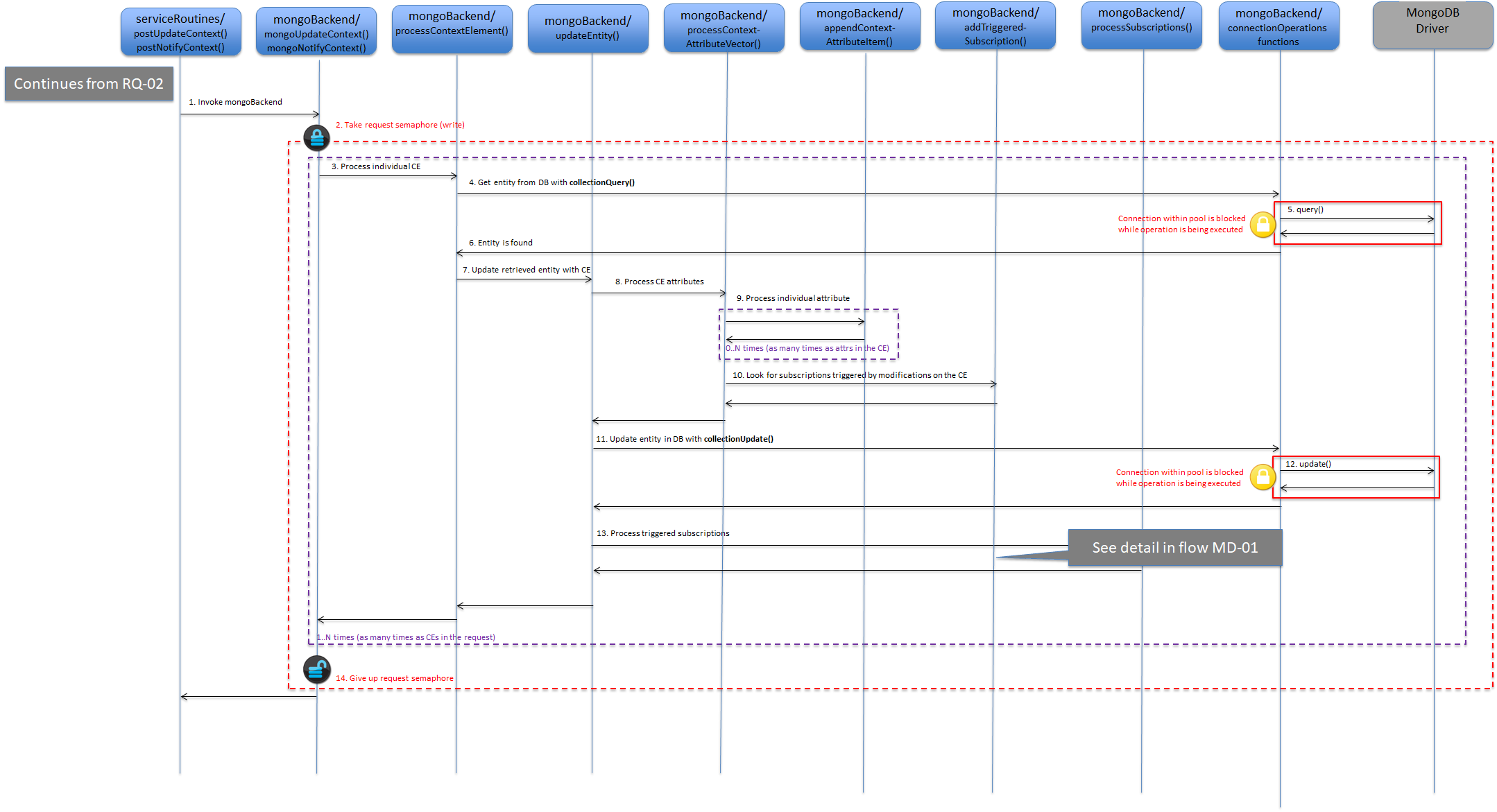
MB-03: mongoUpdate APPEND/APPEND_STRICT case with existing entity
mongoUpdateContext()ormongoNotifyContext()is invoked from a service routine (step 1).- Depending on
-reqMutexPolicy, the request semaphore may be taken (write mode) (step 2). See this document for details. - In a loop,
processContextElement()is called for eachEntityobject (Entity, in short) of the incoming request (step 3). - After precondition checks,
processContextElement()processes an individual Entity. First, the entity corresponding to that Entity is searched in the database, usingcollectionQuery()in theconnectionOperationsmodule (steps 4 and 5). Let's assume that the entity is found (step 6). - The execution flow passes to
updateEntity()that is in charge of doing the entity update (step 7).updateEntity()in its turn passes the flow toprocessContextAttributeVector()in order to process the attributes in the Entity (step 8). processContextAttributeVector()callsappendContextAttributeItem()in a loop to process each individual attribute in the Entity (step 9). More details regarding the strategy used to implement this processing later.-
Once the processing of the attributes is done,
processContextAttributeVector()callsaddTriggeredSubscriptions()to detect subscriptions triggered by the update operation (step 10). More details on this later. -
When the control is returned to
updateEntity(),collectionUpdate()in theconnectionOperationsmodule is invoked to actually update the entity in the database (steps 11 and 12). - The next step is to send the notifications triggered by the update operation, which is done by
processSubscriptions()(step 13). More details on this in (diagram MD-01). - If the request semaphore was taken in step 2, then it is released before returning (step 14).
Case 4: action type is "APPEND" or "APPEND_STRICT" and the entity is not found.
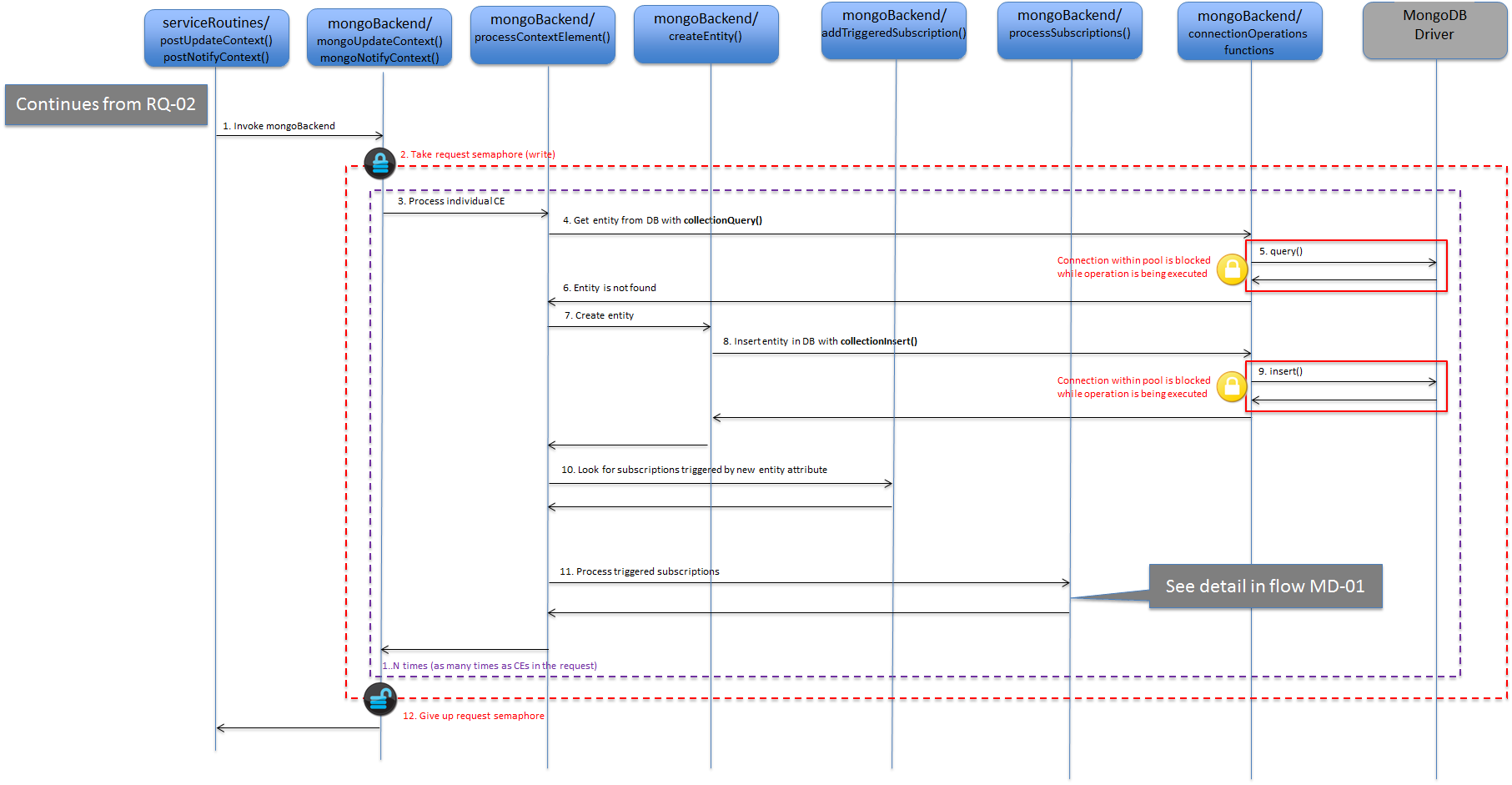
MB-04: mongoUpdate APPEND/APPEND_STRICT case with new entity
mongoUpdateContext()ormongoNotifyContext()is invoked from a service routine (step 1).- Depending on
-reqMutexPolicy, the request semaphore may be taken (write mode) (step 2). See this document for details. - In a loop,
processContextElement()is called for eachEntityobject (Entity, in short) of the incoming request (step 3). - After precondition checks,
processContextElement()processes an individual Entity. First, the entity corresponding to that Entity is searched in the database, usingcollectionQuery()in theconnectionOperationsmodule (steps 4 and 5). Let's assume that the entity is not found (step 6). - The execution flow passes to
createEntity()that in charge of creating the entity (step 7). The actual creation of the entity in the database is done bycollectionInsert()in theconnectionOperationsmodule (steps 8 and 9). - Control is returned to
processContextElement(), which callsaddTriggeredSubscriptions()in order to detect subscriptions triggered by the update operation (step 10). More details on this later. - The next step is to send notifications triggered by the update operation, by calling
processSubscriptions()(step 11). More details on this in (diagram MD-01). - If the request semaphore was taken in step 2, then it is released before returning (step 12).
Case 5: action type is "DELETE" to partially delete some attributes of an entity.
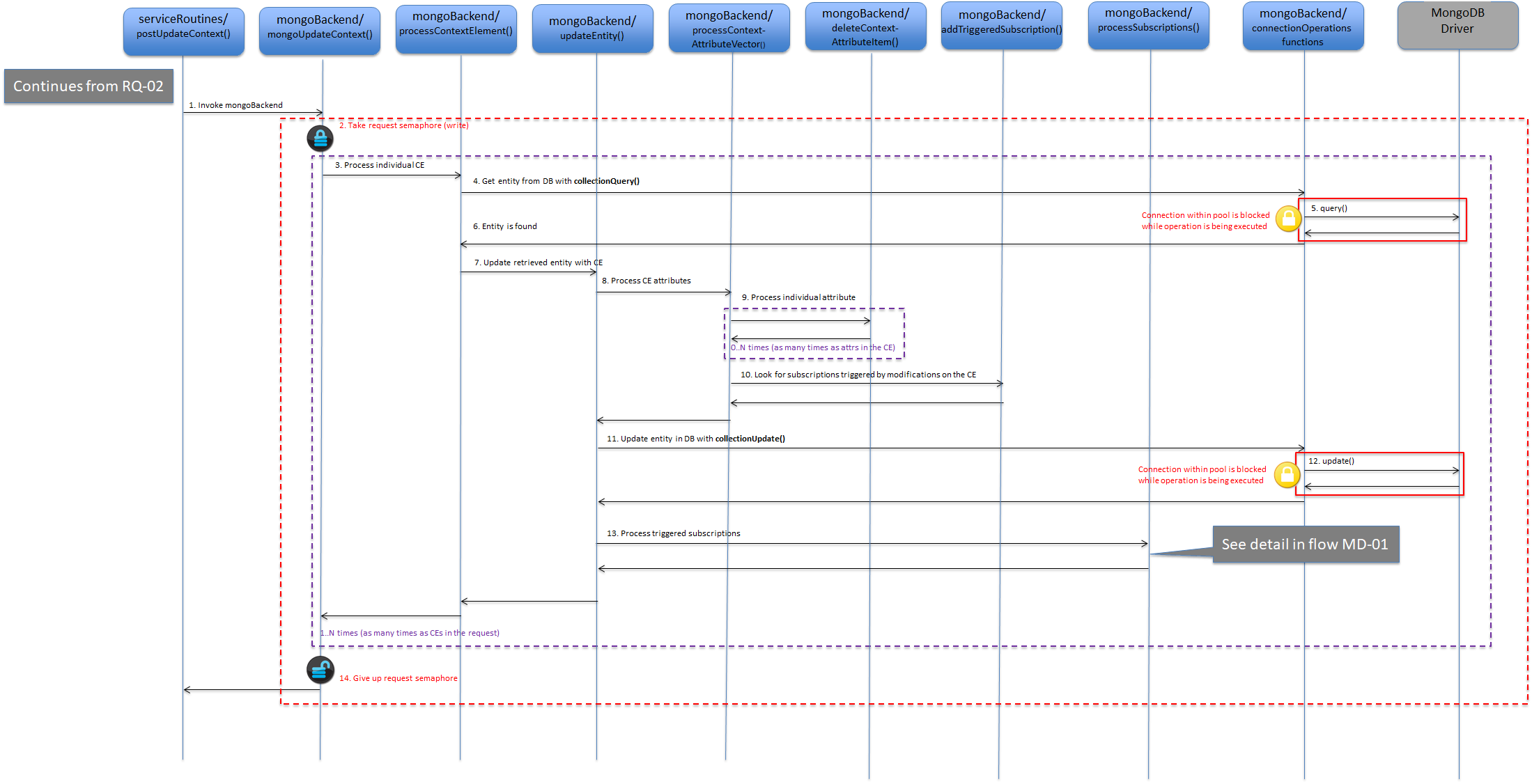
MB-05: mongoUpdate DELETE not remove entity
mongoUpdateContext()is invoked from a service routine (step 1).- Depending on
-reqMutexPolicy, the request semaphore may be taken (write mode) (step 2). See this document for details. - In a loop,
processContextElement()is invoked for eachEntityobject (Entity, in short) of the incoming request (step 3). - After precondition checks,
processContextElement()processes an individual Entity. First, the entity corresponding to that Entity is searched in the database, by callingcollectionQuery()in theconnectionOperationsmodule (steps 4 and 5). Let's assume that the entity is found (step 6). - The execution flow passes to
updateEntity(), thqat is in charge of doing the entity update (step 7).updateEntity()in its turn passes the flow toprocessContextAttributeVector()in order to process the attributes of the Entity (step 8). processContextAttributeVector()callsdeleteContextAttributeItem()in a loop over each individual attribute in the Entity (step 9). More details regarding the strategy used to implement this processing later.- Once the processing of the attributes is done,
processContextAttributeVector()callsaddTriggeredSubscriptions()in order to detect subscriptions triggered by the update operation (step 10). More details on this later. - When the control is returned to
updateEntity(),collectionUpdate()in theconnectionOperationsmodule is invoked to update the entity in the database (steps 11 and 12). - The next step is to send notifications triggered by the update operation, by invoking
processSubscriptions()(step 13). More details on this in (diagram MD-01). - If the request semaphore was taken in step 2, then it is released before returning (step 14).
Case 6: action type is "DELETE" to remove an entity
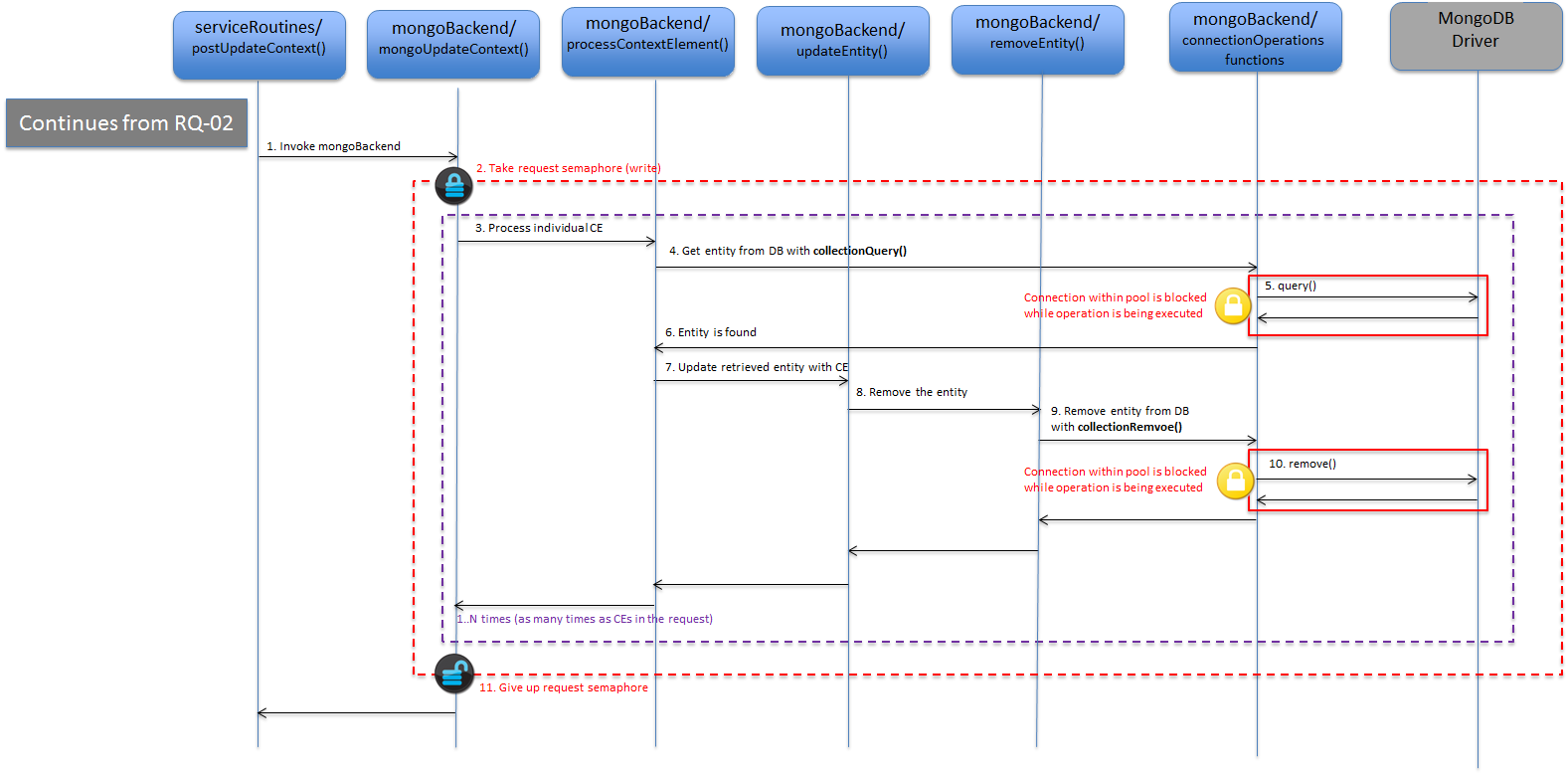
MB-06: mongoUpdate DELETE remove entity
mongoUpdateContext()is invoked from a service routine (step 1).- Depending on
-reqMutexPolicy, the request semaphore may be taken (write mode) (step 2). See this document for details. - In a loop,
processContextElement()is called for eachEntityobject (Entity, in short) of the incoming request (step 3). - After precondition checks,
processContextElement()processes an individual Entity. First, the entity corresponding to that Entity is searched in the database, by invokingcollectionQuery()in theconnectionOperationsmodule (steps 4 and 5). Let's assume that the entity is found (step 6). - The execution flow passes to
updateEntity(), in charge of doing the entity update (step 7).updateEntity()in its turn passes the flow toremoveEntity()in order to do the actual entity removal (step 8). removeEntity()invokescollectionRemove()in theconnectionOperationsmodule in order to actually remove the entity in the database (steps 9 and 10).- If the request semaphore was taken in step 2, then it is released before returning (step 11).
Next, we are going to describe some implementation aspects that are common to several of the cases described above.
Regarding the strategy used in processContextAttributeVector() to implement entity update, this function keeps several variables that hold a "delta" of modifications (to be applied to the entity in the database), in particular:
toSet: attributes that need to be added to or updated in the entityattrsfield in the database, using the$setoperator.toUnset: attributes that need to be removed from the entityattrsfield in the database, using the$unsetoperator.toPush: attributes that need to be added to the entityattrsNamefield in the database (list of attribute names), using the$addToSetand$eachoperators.toPull: attributes that need to be removed from theattrsNamefield in the database (list of attribute names), using the$pullAlloperator.locAttrandgeoJsonare related to modifications in the geolocation information associated to the entity (entitylocationfield in the database).dateExpirationanddateExpirationInPayloadare related to modifications in the TTL expiration date information associated to a transient entity (entityexpDatefield in the database).
The update is based on "deltas" rather than setting the whole attrs and attrsName due to the fact that updates can be done concurrently in the database to the same entity (by different request threads in the same CB process or by different CB processes running in different nodes in active-active configurations) and attrs/attrsName set by one thread could ruin attrs/attrsName for the other thread.
These variables are returned to updateEntity() as output parameters, to be used in the entity update operation on the database (as shown in the diagrams above)
In order to fill toSet, toUnset, etc. processContextAttributeVector() processes the attributes in the incoming Entity. Execution for each attribute processing is delegated to a per-attribute processing function:
updateContextAttributeItem(), if action type is UPDATE or REPLACE.updateAttribute()is used internally as a helper function (which in its turn may usemergeAttrInfo()to merge the attribute information in the database and in the incoming Entity).appendContextAttributeItem(), if action type is APPEND or APPEND_STRICT.appendAttribute()is used internally as a helper function, passing the ball toupdateAttribute()if the attribute already exists in the entity and it isn't an actual append.deleteContextAttributeItem(), if action type is DELETE.deleteAttribute()is used internally as a helper function.
During the update process, either in the case of creating new entities or updating existing ones, context subscriptions may be triggered, so notifications would be sent. In order for this to work, the update logic keeps a map subsToNotify to hold triggered subscriptions. addTriggeredSubscriptions() is in charge of adding new subscriptions to the map, while processSubscriptions() is in charge of sending the notifications once the process has ended, based on the content of the map subsToNotify. Both addTriggeredSubscriptions() and processSubscriptions() invocations are shown in the context of the different execution flow cases in the diagrams above.
addTriggeredSubscriptions(). Actually, there are two versions of this function (addTriggeredSubscriptions()itself is just a dispatcher): the_withCache()version (which uses the subscription cache to check whether a particular entity modification triggers any subscriptions) and_noCache()(which checks thecsubscollection in the database in order to do the checking). Obviously, the version to be used depends on whether the subscription cache is enabled or not, i.e. the value of the globalnoCachebool variable. The_withCache()version needs to take/give the subscription cache semaphore (see this document for details).processSubscriptions(). Apart from thesubsToNotifymap, another important parameter in this function isnotifyCerP, which is a reference to the context element response (CER) that will be used to fill in the notifications to be sent. In the case of new entities, this CER is built from the contents of the incoming Entity in the update request. In the case of updating an existing entity, the logic starts with CER and updates it at the same time thetoSet,toUnset, etc. fields are built. In other words, the logic keeps always an updated CER while the Entity attributes are being processed.updateAttrInNotifyCer()(used inupdateContextAttributeItem()andupdateContextAttributeItem()) anddeleteAttrInNotifyCer()(used indeleteContextAttributeItem()) are helper functions used to do this task. Details on this are shown in the sequence diagram below.
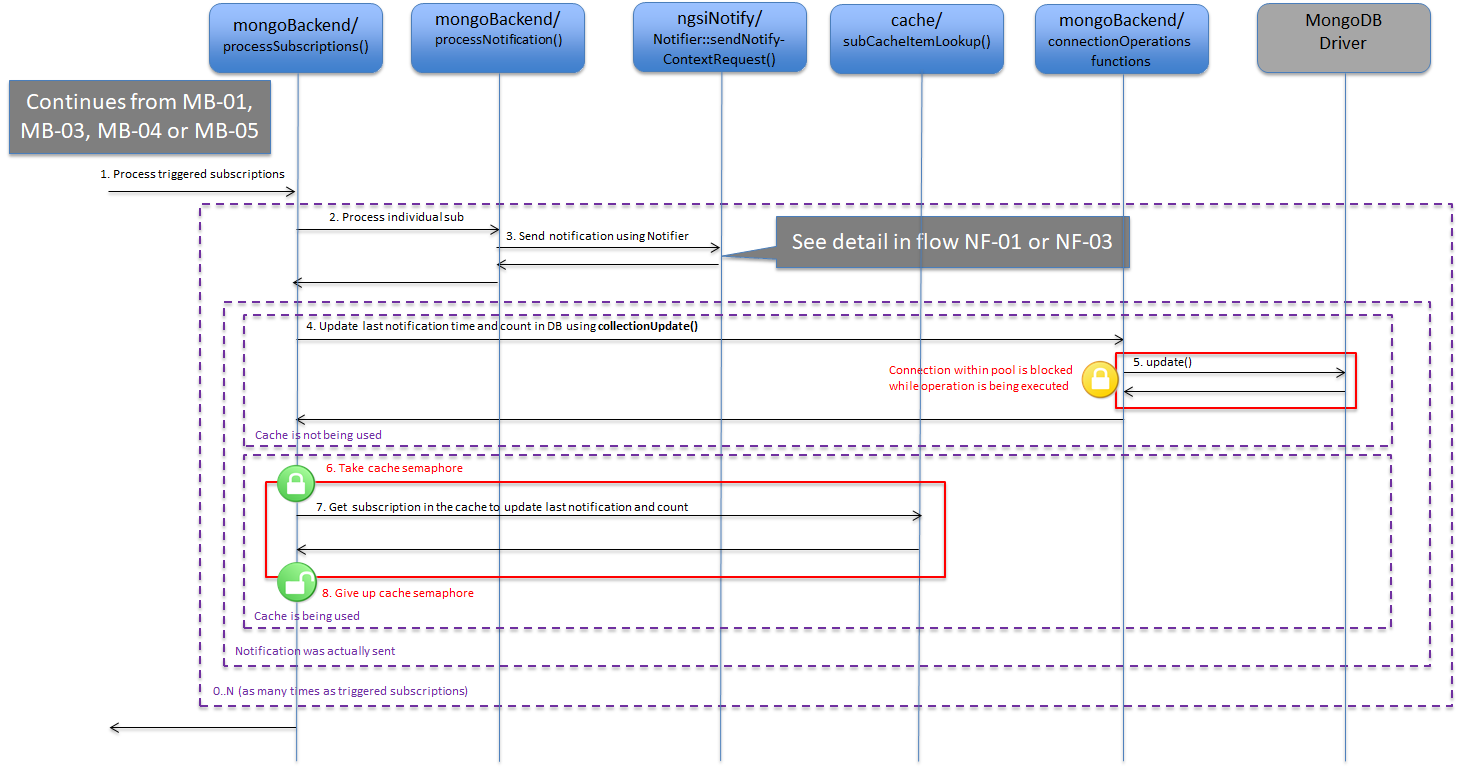
MD-01: processSubscriptions() function detail
processSubscriptions()is invoked (step 1) from a number of places. See diagrams MB-01, MB-03, MB-04 and MB-05. Each individual triggered subscription is handled in a loop by callingprocessNotification().processNotification()is called (step 2), which in its turn uses theNotifierobject (from ngsiNotify library) in order to send the notification (step 3). The detail is described in diagrams NF-01 and NF-03.- The next steps are done only in case a notification was actually sent. Depending on cache usage:
- If subscription cache is not being used, then the last notification time and count in the database are updated in the database, using
collectionUpdate()in theconnectionOperationsmodule (steps 4 and 5). - If subscription cache is being used, then the subscription is retrieved from the subscription cache calling
subCacheItemLookup()(step 7). Next, last notification time and count are modified in the subscription cache (they will be consolidated in the database in the next subscription cache refresh, see details in this document). The access to the subscription cache is protected by the subscription cache semaphore (see this document for details), which is taken and released in steps 6 and 8 respectively.
- If subscription cache is not being used, then the last notification time and count in the database are updated in the database, using
Finally, in the case of action type "UPDATE/REPLACE", the context update logic is able to "fill the gaps" for missing entities/attributes in the local database with Context Provider information. This is done in searchContextProviders(). The detail is shown in the sequence diagram below.
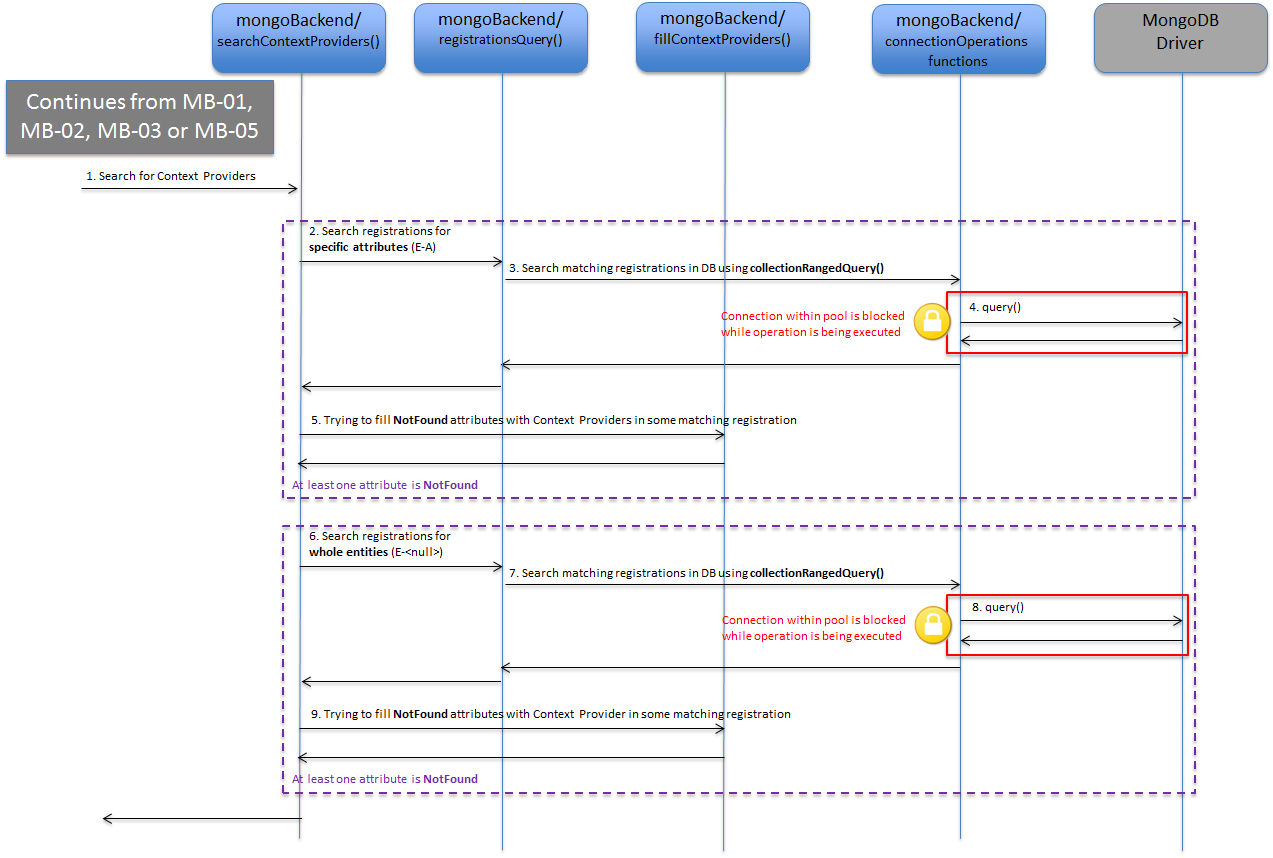
MD-02: searchContextProviders() function detail
searchContextProviders()is invoked (step 1) from one of four possible flows. See diagrams MB-01, MB-02, MB-03 and MB-05. Apart from these entry points, note thatsearchContextProviders()can also be called fromupdateEntity(), in caseprocessContextAttributeVector()fails (which means that the entity wasn't actually modified locally, so it makes sense to search for Context Providers).- If at least one attribute has the
foundflag set tofalse, a lookup for matching registrations based on specific attributes (i.e. in the form "E-A") is done, callingregistrationsQuery()in theMongoGlobalmodule (step 2). This function searches the database usingcollectionRangedQuery()in theconnectionOperationsmodule (steps 3 and 4). - Then,
fillContextProviders()(in theMongoGlobalmodule) is called to attempt to fill the not found attributes with the matching registrations (step 5). - If at least one attribute still has the
foundflag set tofalse, a new lookup round is done. This time, searching for whole entities (i.e. in the "E-<null>" form). Again,registrationsQuery()is used (step 6). This function searches the database usingcollectionRangedQuery()in theconnectionOperationsmodule (steps 7 and 8). - Then,
fillContextProviders()(in theMongoGlobalmodule) is called again to attempt to fill the not found attributes with the new matched registrations (step 9).
mongoQueryContext (SR)
mongoQueryContext encapsulates the logic for the query context operation.
The header file contains only a function named mongoQueryContext() which uses a QueryContextRequest object as input parameter and a QueryContextResponse as output parameter. Its purpose is to build a response object based on a request object and entities (for locally retrieved information) and registrations (for "pointers" to Context Providers to be used in the forwarding logic in the calling serviceRoutine) existing in the database.
The details are shown in the sequence diagram below.
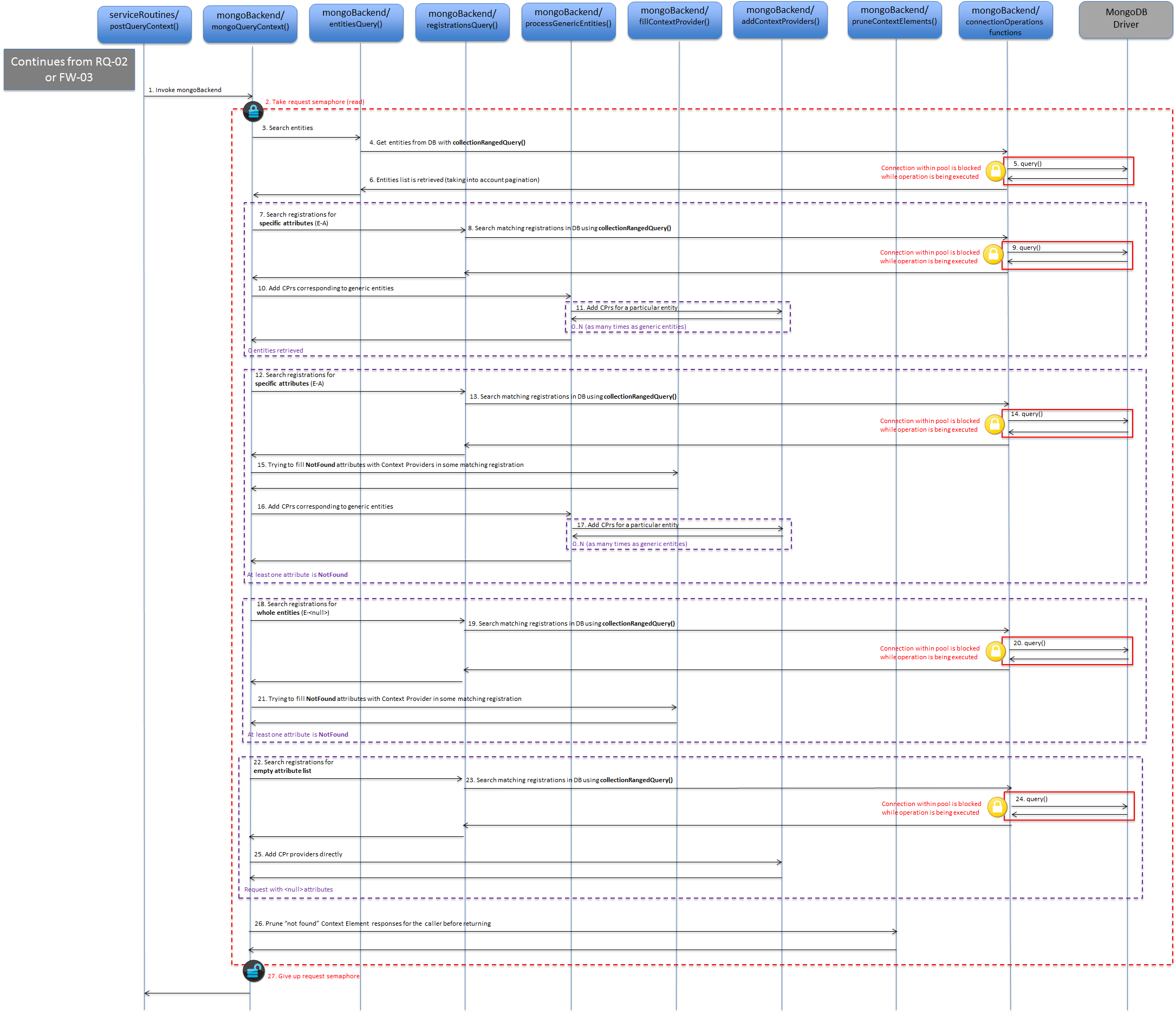
MB-07: mongoQueryContext
mongoQueryContext()is invoked from a service routine (step 1).- Depending on
-reqMutexPolicy, the request semaphore may be taken (read mode) (step 2). See this document for details. - The execution flow passes to
entitiesQuery()in theMongoGlobalmodule (step 3). entitiesQuery()basically searches for entities in the database (entitiescollection, described as part of the database model in the administration documentation). More information on this function can be found in theMongoGlobalmodule section. It relies oncollectionRangedQuery()in theconnectionOperationsmodule in order to do the actual query in the database (steps 4, 5 and 6). After the query in the database, a part of the function annotates results in order to help in the Context Providers search done by the calling function, using thefoundattribute flag (see details in the source code). The result is then provided in aContextElementResponseVectorobject, as output parameters.- Steps 7 to 11 are related to context providers lookup and done only in the case no entity was found in the database.
- A lookup for matching registrations based on specific attributes (i.e. in the form "E-A") is done, calling
registrationsQuery()in theMongoGlobalmodule (step 7). This function searches the database usingcollectionRangedQuery()in theconnectionOperationsmodule (steps 8 and 9). processGenericEntities()is called in order to add context providers corresponding to generic entities (step 10).- A loop over generic entities is implemented to add context provider for each such entity, using
addContextProviders()(step 11). - Steps 12 to 17 are done only if at least one attribute has the
foundflag set tofalse. - A lookup for matching registrations based on specific attributes (i.e. in the form "E-A") is done, calling
registrationsQuery()in theMongoGlobalmodule (step 12). This function searches the database usingcollectionRangedQuery()in theconnectionOperationsmodule (steps 13 and 14). - After that,
fillContextProviders()(in theMongoGlobalmodule) is called to attempt to fill the not found attributes with the matched registrations (step 15). processGenericEntities()is called to add context providers corresponding to generic entities (step 16).- A loop on generic entities is implemented to add context provider for each such entity, by calling
addContextProviders()(step 17). - Steps 18 to 21 are done only if at least one attribute still has the
foundflag set tofalse. - A lookup for matching registrations based on whole entities (i.e. in the form "E-<null>") is done, calling
registrationsQuery()in theMongoGlobalmodule (step 18). This function searches the database usingcollectionRangedQuery()in theconnectionOperationsmodule (steps 19 and 20). - After that,
fillContextProviders()(in theMongoGlobalmodule) is called to attempt to fill the not found attributes with the matched registrations (step 21). - Steps 22 to 25 are done only in case the request contains a null list of attributes, i.e. querying for the whole entity.
- A lookup for matching registrations with empty attribute list is done, calling
registrationsQuery()in theMongoGlobalmodule (step 22). This function searches the database usingcollectionRangedQuery()in theconnectionOperationsmodule (steps 23 and 24). - Context providers are added directly, by
addContextProviders()(step 25). - A "pruning" step is done in order to remove not found elements (i.e. no result from either the local database nor from any context provider). This is done by
pruneContextElements()in theMongoGlobalmodule (step 26). - If the request semaphore was taken in step 2, then it is released before returning (step 27).
By generic entities above we mean one of the following:
- Entities with regular id (i.e. not a pattern) and null type
- Entities with patterned id and not null type
- Entities with patterned id and null type
mongoQueryTypes (SR and SR2)
mongoQueryTypes encapsulates the logic for the different operations in the NGSIv1 and NGSIv2 APIs that allow type browsing.
The header file contains three functions:
mongoEntityTypes()(SR and SR2): it serves theGET /v1/contextTypesandGET /v2/types(withoutoptions=values) operations.mongoEntityTypesValues()(SR2): it serves theGET /v2/types?options=valuesoperation.mongoAttributesForEntityType()(SR and SR2): it serves theGET /v1/contextTypes/{type}andGET /v2/types/{type}operations.
The detail for mongoEntityTypes() is as shown in the following diagram.
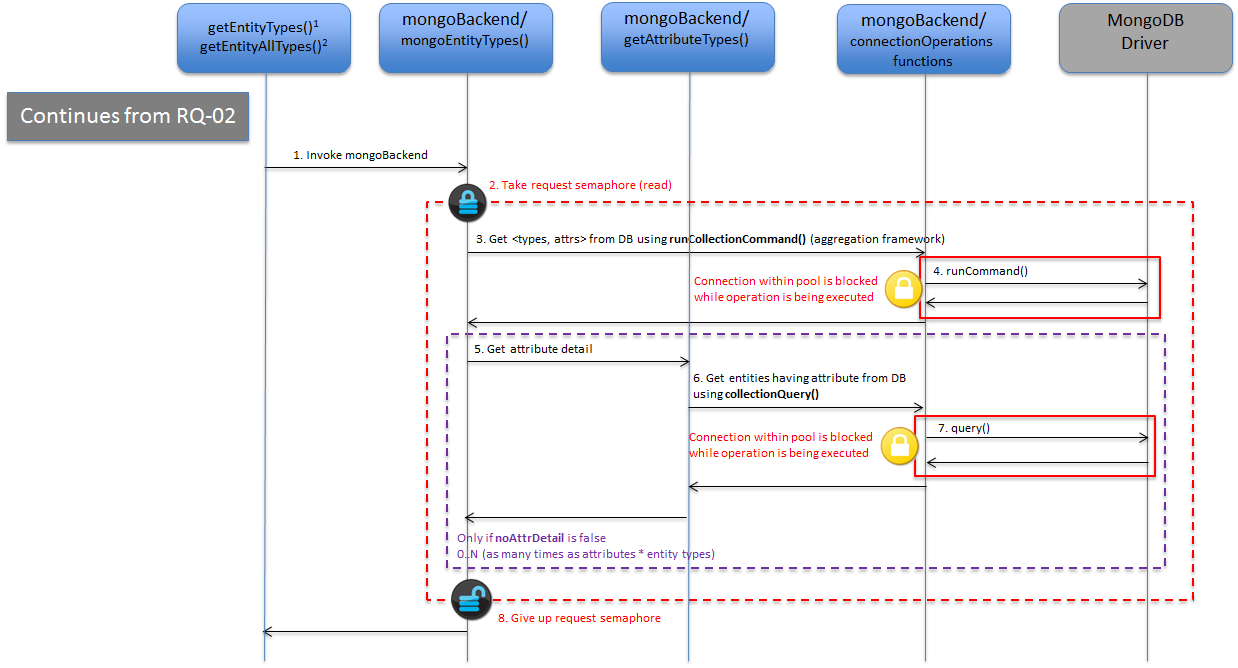
MB-08: mongoEntityTypes
mongoEntityTypes()is invoked from a service routine (step 1). This can be from eithergetEntityTypes()(which resides inlib/serviceRoutines/getEntityTypes.cpp) orgetEntityAllTypes()(which resides inlib/serviceRoutinesV2/getEntityAllTypes.cpp).- Depending on
-reqMutexPolicy, the request semaphore may be taken (read mode) (step 2). See this document for details. - A list of entity types and of attributes belonging to each of those entity types is retrieved from the database, using
runCollectionCommand()in theconnectionOperationsmodule, to run an aggregation command (steps 3 and 4). - If attribute detail is enabled (i.e.
noAttrDetailset tofalse) a loop iterates on every attribute of every entity type, in order to: - Invoke
getAttributeTypes()to get the different types of the attributes (along with the entities of the same entity type) (step 5). - The information is retrieved from the database using
collectionQuery()in theconnectionsOperationmodule (steps 6 and 7). - If the request semaphore was taken in step 2, then it is released before returning (step 8).
The detail for mongoEntityTypesValues() is as shown in the following diagram.
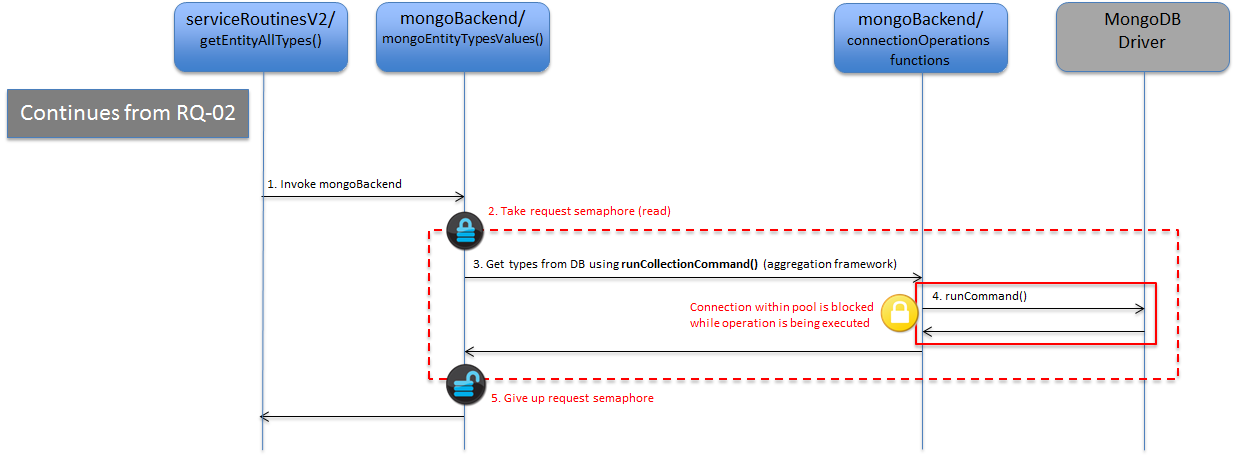
MB-09: mongoEntityTypesValues
mongoEntityTypesValues()is invoked from a service routine (step 1)- Depending on
-reqMutexPolicy, the request semaphore may be taken (read mode) (step 2). See this document for details. - A list of entity types is retrieved from the database, using
runCollectionCommand()in theconnectionOperationsmodule to run an aggregation command (steps 3 and 4). - If the request semaphore was taken in step 2, then it is released before returning (step 5).
The detail for mongoAttributesForEntityType() is as shown in the following diagram.
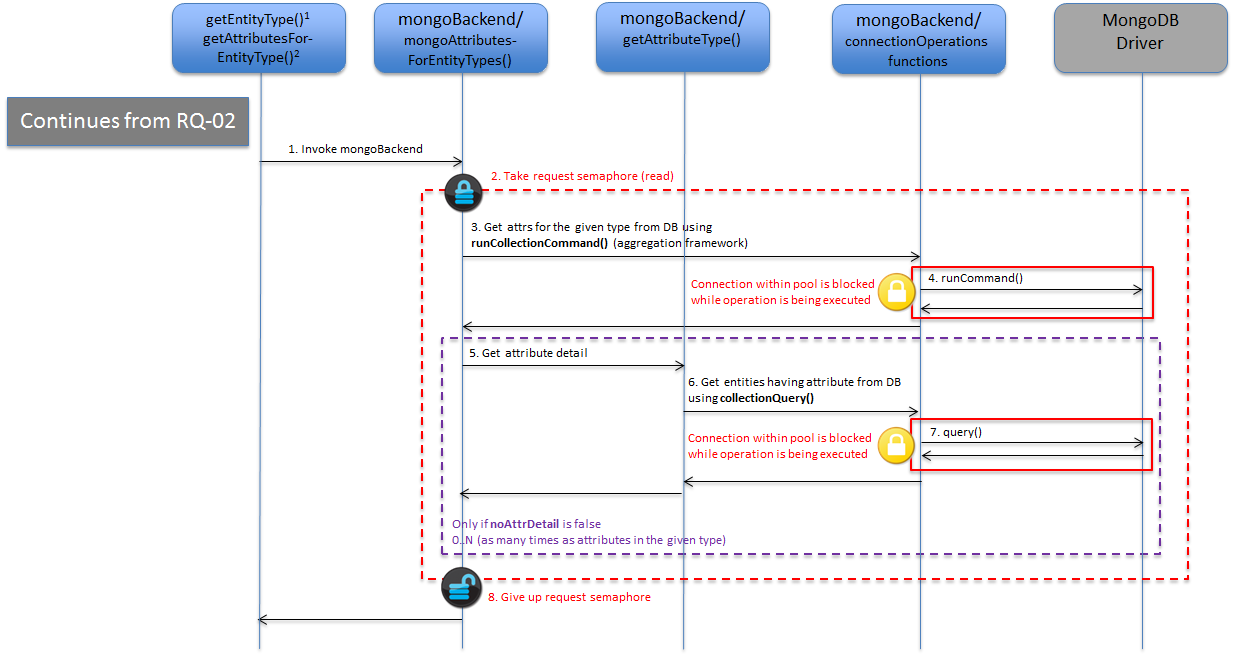
MB-10: mongoAttributesForEntityType
mongoAttributesForEntityType()is invoked from a service routine (step 1). This can be from eithergetEntityType()(which resides inlib/serviceRoutinesV2/getEntityType.cpp) orgetAttributesForEntityType()(which resides inlib/serviceRoutines/getAttributesForEntityType.cpp).- Depending on
-reqMutexPolicy, the request semaphore may be taken (read mode) (step 2). See this document for details. - A list of entity attributes corresponding to the entity type is retrieved from the database, using
runCollectionCommand()in theconnectionOperationsmodule to run an aggregation command (steps 3 and 4). - If attribute detail is enabled (i.e.
noAttrDetailset tofalse) a loop iterates on every attribute in order to: - Invoke
getAttributeTypes()to get the different types of the attributes (along with the entities of the same entity type) (step 5). - The information is retrieved from the database using
collectionQuery()in theconnectionsOperationmodule (steps 6 and 7). - If the request semaphore was taken in step 2, then it is released before returning (step 8).
These functions use EntityTypeVectorResponse (two first cases) and EntityTypeResponse objects in order to return results to calling service routine.
Note the usage of the noAttrDetails parameter in mongoEntityTypes() and mongoAttributesForEntityType() in order to avoid a (potentially costly) process to get types of the attributes associated to an entity type (implemented by getAttributeTypes()).
All the above functions heavily rely on the MongoDB aggregation framework. You should be familiar with this framework (and with the entities collection structure, described as part of the database model in the administration documentation) in order to understand how the functions work.
mongoCreateSubscription (SR2)
mongoCreateSubscription encapsulates the context subscription creation logic.
The header file contains only the function mongoCreateSubscription() whose work is basically to get the information from a Subscription object and insert the corresponding document in the csubs collection in the database (described as part of the database model in the administration documentation). The new subscription is also inserted in the subscription cache (if the cache is enabled).
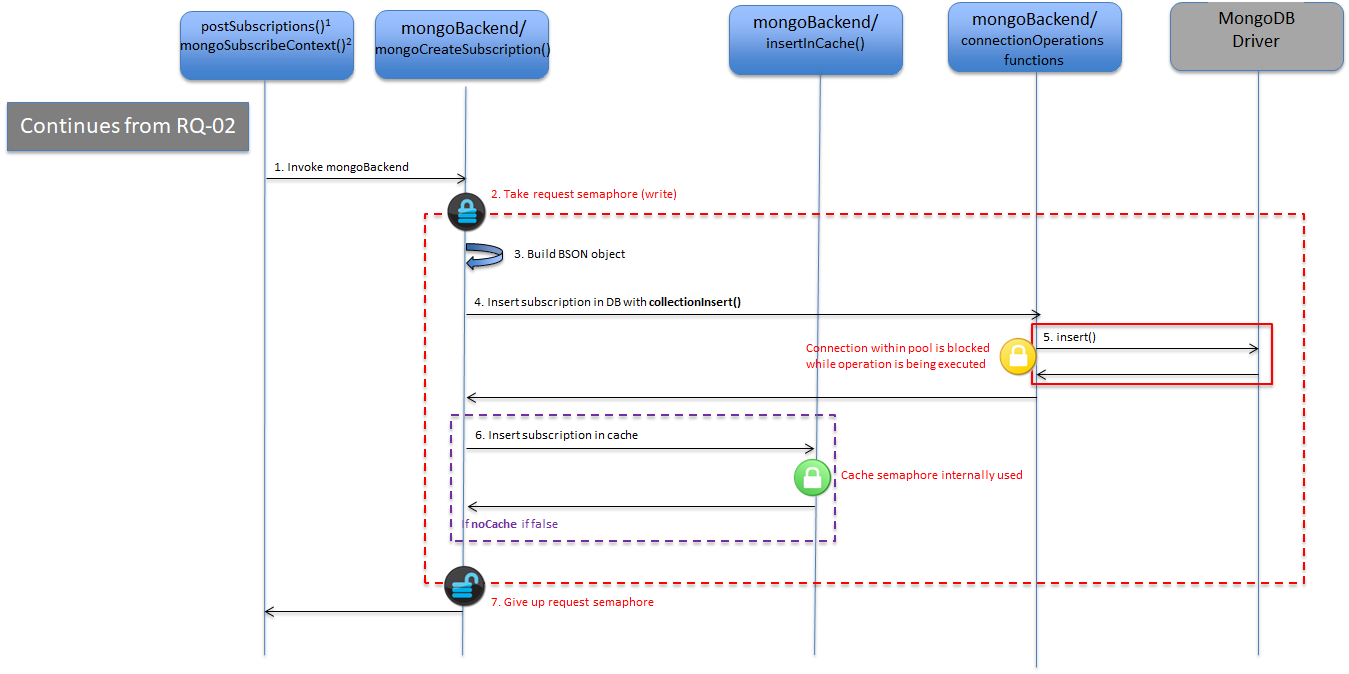
MB-11: mongoCreateSubscription
mongoCreateSubscription()is invoked from a service routine (step 1). This can be from eitherpostSubscriptions()(which resides inlib/serviceRoutinesV2/postSubscriptions.cpp) ormongoSubscribeContext()(which resides inlib/mongoBackend/mongoSubscribeContext.cpp).- Depending on
-reqMutexPolicy, the request semaphore may be taken (write mode) (step 2). See this document for details. - This function builds a BSON object that will be at the end the one to be persisted in the database, using different
set*()functions (setExpiration(),setHttpInfo(), etc.) (step 3). - The BSON object corresponding to the new subscription is inserted in the database using
collectionInsert()in theconnectionOperationsmodule (steps 4 and 5). - If the subscription cache is enabled (i.e.
noCacheset tofalse), the new subscription is inserted in the subscription cache (step 6).insertInCache()uses the subscription cache semaphore internally (see this document for details). - If the request semaphore was taken in step 2, then it is released before returning (step 7).
Note that potential notifications are sent before inserting the subscription in the database/cache, so the correct information regarding last notification times and count is taken into account.
mongoUpdateSubscription (SR2)
mongoUpdateSubscription encapsulates the context subscription update logic.
The header file contains only a function named mongoUpdateSubscription() whose work is basically to get the information from a mongoUpdateSubscription object and use it to update the corresponding document of the csubs collection in the database (described as part of the database model in the administration documentation). The subscription is also updated in the subscription cache (if the subscription cache is enabled).
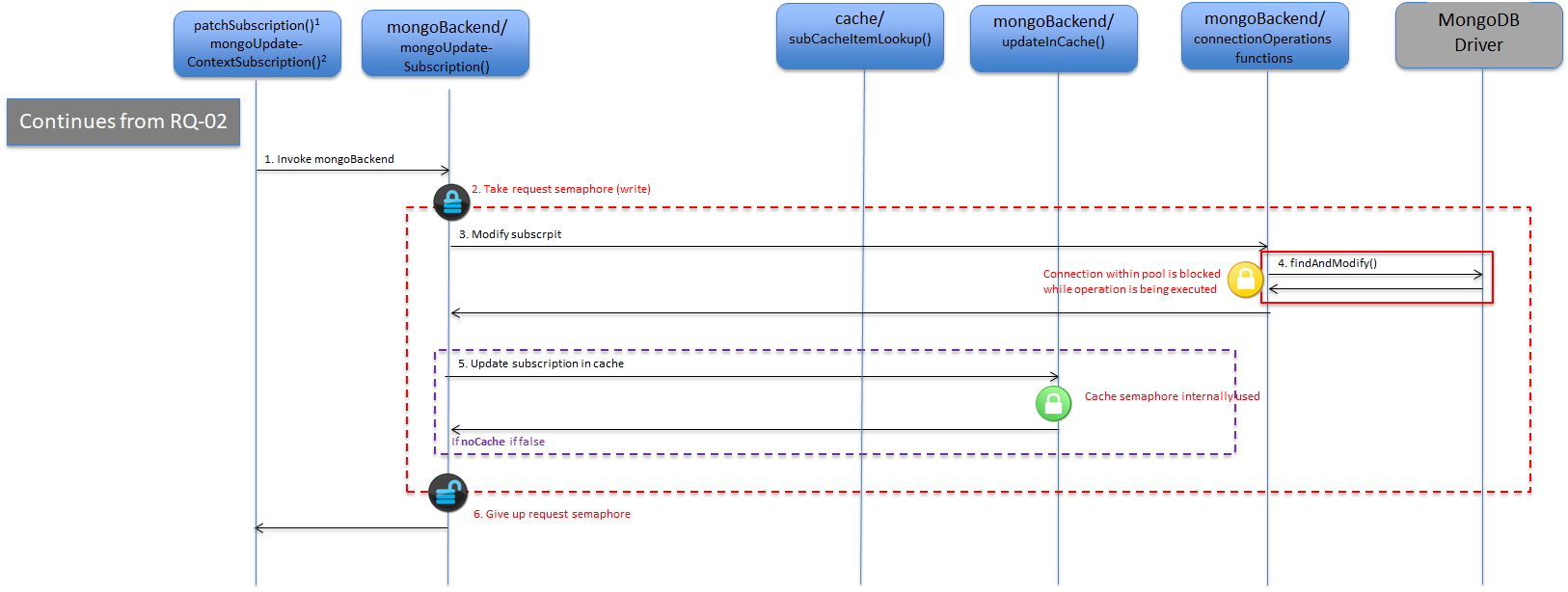
MB-12: mongoUpdateSubscription
mongoUpdateSubscription()is invoked from a service routine (step 1). This can be from eitherpatchSubscription()(which resides inlib/serviceRoutinesV2/patchSubscription.cpp) ormongoUpdateContextSubscription()(which resides inlib/mongoBackend/mongoUpdateContextSubscription.cpp).- Depending on
-reqMutexPolicy, the request semaphore may be taken (write mode) (step 2). See this document for details. - The subscription is updated in DB using MongoDB
$set/$unsetoperators. This operation is done in the functioncolletionFindAndModify()in theconnectionOperationsmodule (steps 3 and 4). - In case the subscription cache is enabled (i.e.
noCacheset tofalse) the subscription is updated in the subscription cache based in the result fromcollectionFindAndModify()in the previous step (step 5).updateInCache()uses the subscription cache semaphore internally. - If the request semaphore was taken in step 2, then it is released before returning (step 6).
Note that potential notifications are sent before updating the subscription in the database/cache, so the correct information regarding last notification times and count is taken into account.
mongoGetSubscriptions (SR2)
mongoGetSubscriptions encapsulates the logic for getting subscriptions.
The header file contains two functions:
mongoGetSubscription(), to get individual subscriptions by id, andmongoListSubscriptions(), to get all subscriptions.
They both return a Subscription object (or a vector of Subscription objects, in the case of get all) with the result.
In both cases, the implementation is based on a query on the csubs collection, (described as part of the database model in the administration documentation).
Regarding mongoGetSubscription():
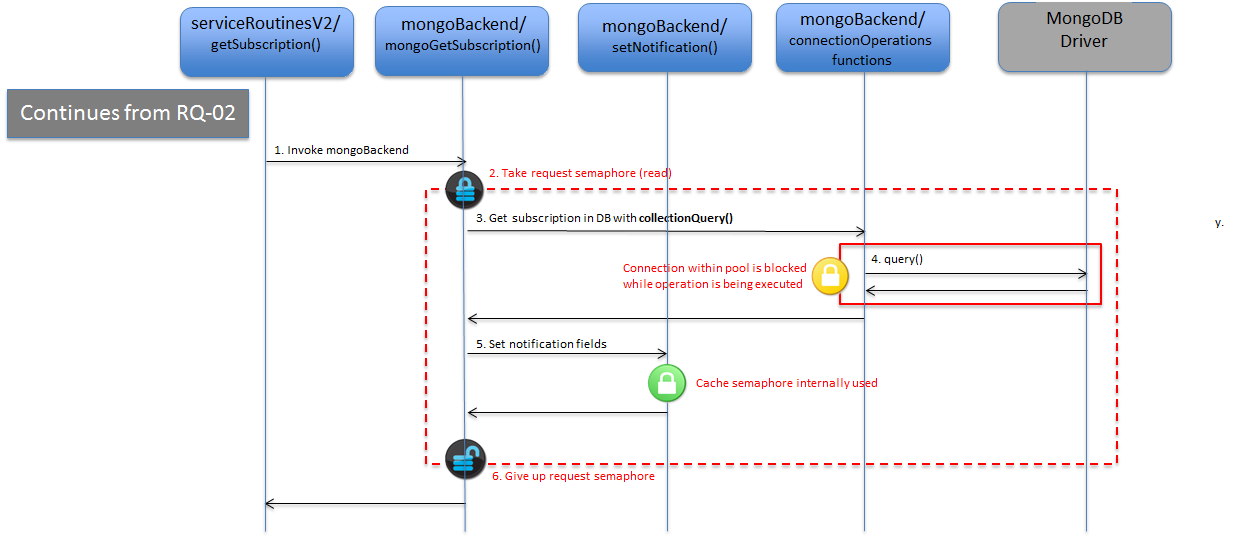
MB-13: mongoGetSubscription
mongoGetSubscription()is invoked from a service routine (step 1).- Depending on
-reqMutexPolicy, the request semaphore may be taken (read mode) (step 2). See this document for details. - The subscription is retrieved from the database using
collectionQuery()in theconnectionOperationsmodule (steps 3 and 4). - Several
set*()functions are used in order to fill theSubscriptionobject to return. Among them (details in source code) we would like to highlightsetNotification()(step 5), as it uses the subscription cache semaphore internally (see this document for details). - If the request semaphore was taken in step 2, then it is released before returning (step 6).
Regarding mongoListSubscriptions():
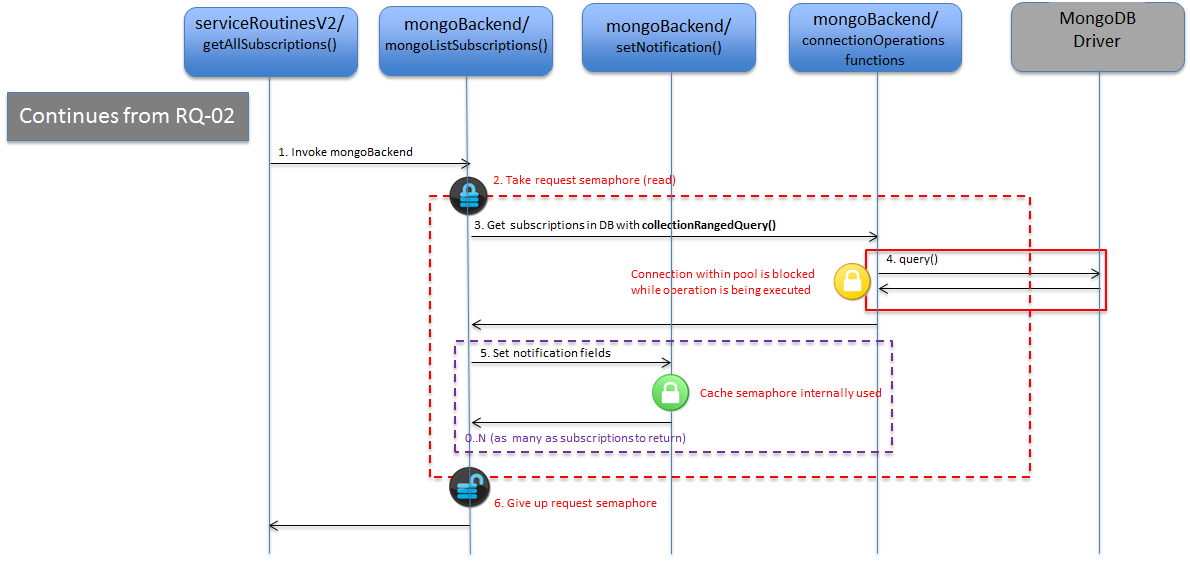
MB-14: mongoListSubscriptions
mongoListSubscriptions()is invoked from a service routine (step 1).- Depending on
-reqMutexPolicy, the request semaphore may be taken (read mode) (step 2). See this document for details. - The subscription is retrieved from the database using
collectionRangedQuery()in theconnectionOperationsmodule (steps 3 and 4). - For each subscription to return, several
set*()functions are used in order to fill theSubscriptionobjects. Among them (details in source code) we would like to highlightsetNotification()(step 5), as it uses the subscription cache semaphore internally (see this document for details). - If the request semaphore was taken in step 2, then it is released before returning (step 6).
mongoUnsubscribeContext (SR and SR2)
mongoUnsubscribeContext encapsulates the logic for unsubscribe context operation (NGSIv1) and remove subscription (NGSIv2).
The header file contains only the function mongoUnsubscribeContext() which uses an UnsubscribeContextRequest object as input parameter and an UnsubscribeContextResponse as output parameter.
Its work is to remove from the database the document associated to the subscription in the csubs collection. The subscription is also removed from the cache (if cache is enabled).
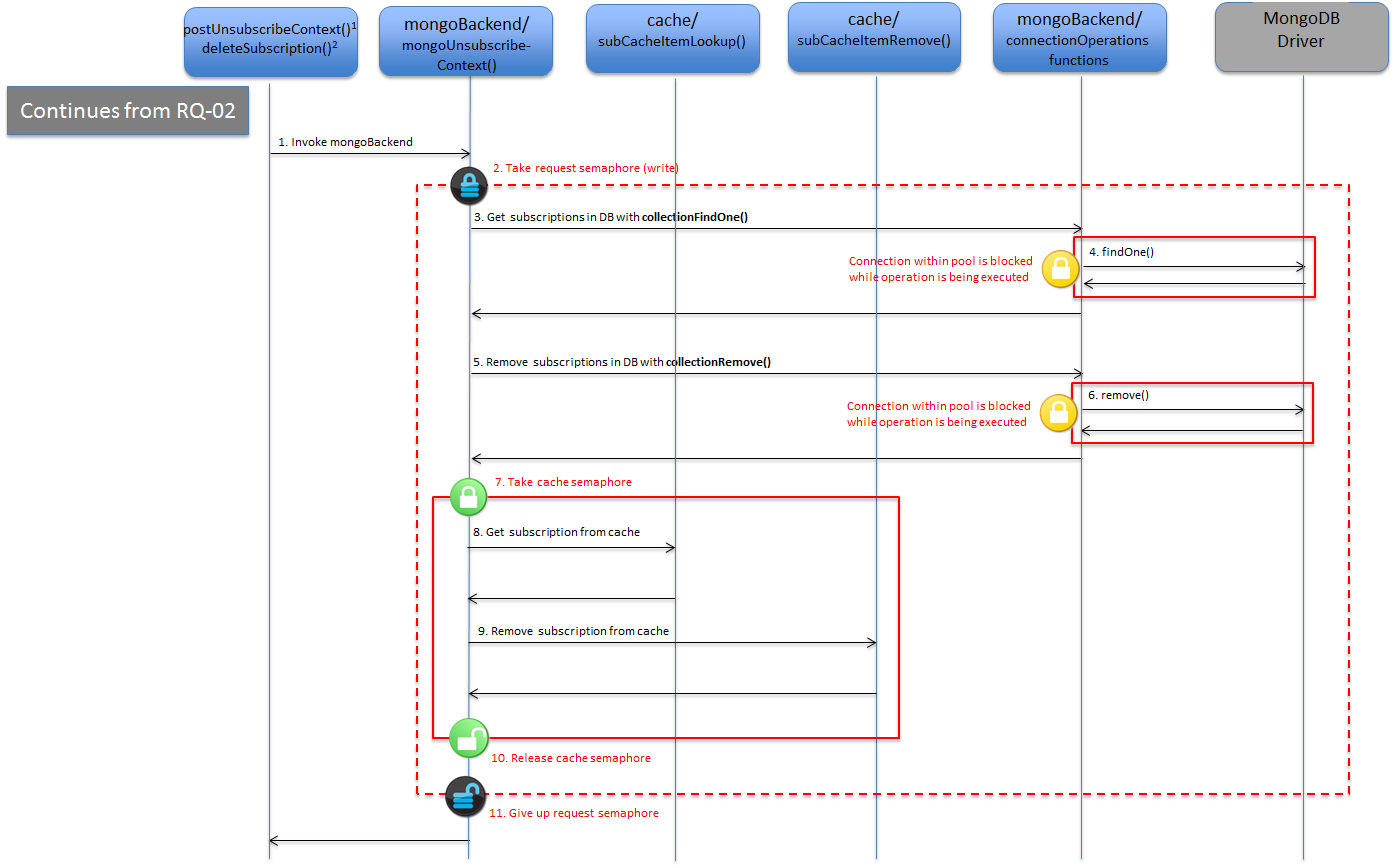
MB-15: mongoUnsubscribeContext
mongoUnsubscribeContext()is invoked from a service routine (step 1). This can be from eitherpostUnsubscribeContext()(which resides inlib/serviceRoutines/postUnsubscribeContext.cpp) ormongoUpdateContextSubscription()(which resides inlib/serviceRoutinesV2/deleteSubscription.cpp).- Depending on
-reqMutexPolicy, the request semaphore may be taken (write mode) (step 2). See this document for details. - The subscription is retrieved from the database using
collectionFindOne()in theconnectionOperationsmodule (steps 3 and 4). - The subscription is removed from the database using
collectionRemove()in theconnectionOperationsmodule (steps 5 and 6). - The subscription is also deleted from the subscription cache (steps 8 and 9). Cache access is protected by the subscription cache semaphore (see this document for details), which is taken and released in steps 7 and 10 respectively.
- If the request semaphore was taken in step 2, then it is released before returning (step 11).
Note that steps 6 and 7 are done no matter the value of noCache. This works but it is inefficient. It should be fixed (an issue has been created about it).
mongoSubscribeContext (SR)
mongoSubscribeContext encapsulates the logic for subscribe context (NGSIv1) operation.
The header file contains only a function named mongoSubscribeContext() which uses a SubscribeContextRequest object as input parameter and a SubscribeContextResponse as output parameter.
Actually, this function is a wrapper of the NGSIv2 version of this operation, i.e. mongoCreateSubscription() in the mongoCreateSubscription module.
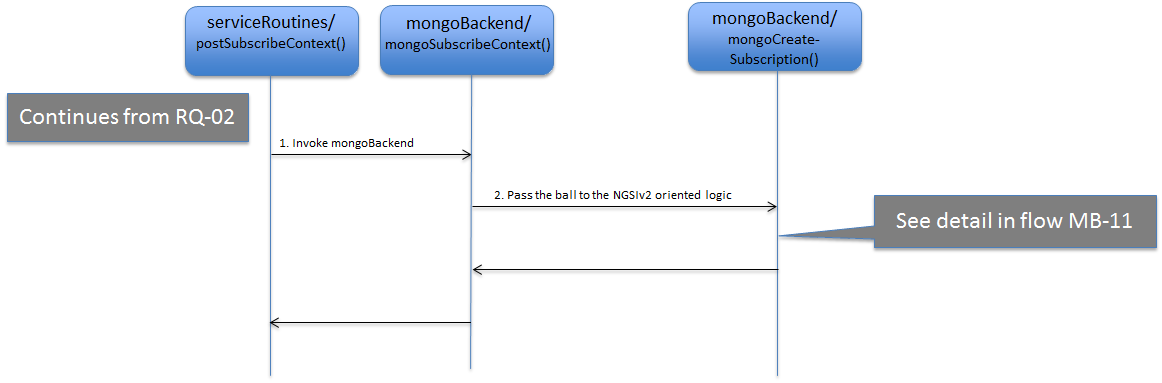
MB-16: mongoSubscribeContext
mongoSubscribeContext()is invoked from a service routine (step 1).- The execution flow is passed to
mongoCreateSubscription()(step 2). See diagram MB-11.
mongoUpdateContextSubscription (SR)
mongoUpdateContextSubscription encapsulates the logic for update context subscription (NGSIv1) operation.
The header file contains only a function named mongoUpdateContextSubscription() which uses an UpdateContextSubscriptionRequest object as input parameter and an UpdateContextSubscriptionResponse as output parameter.
Actually, this function is a wrapper of the NGSIv2 version of this operation, i.e. mongoUpdateSubscription() in the mongoUpdateSubscription module.
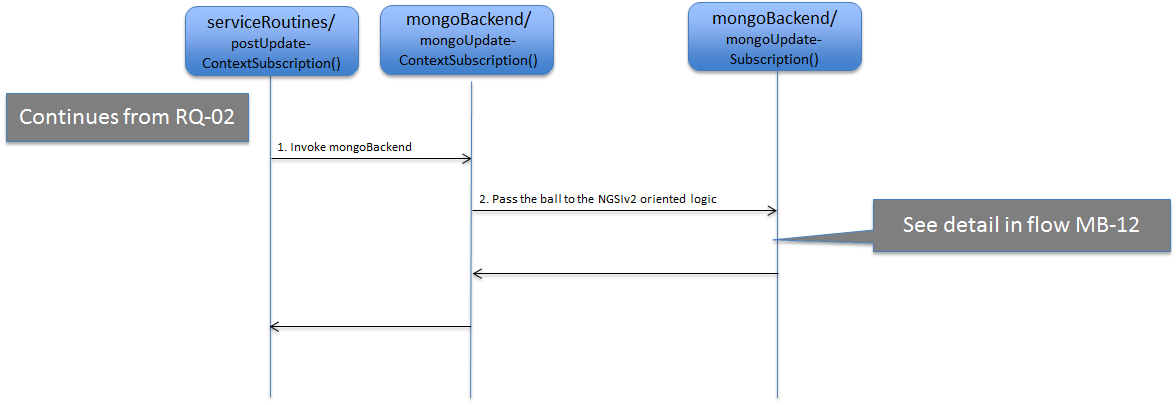
MB-17: mongoUpdateContextSubscription
mongoUpdateContextSubscription()is invoked from a service routine (step 1).- The execution flow is passed to
mongoUpdateSubscription()(setp 2). See diagram MB-12.
mongoRegisterContext (SR)
The mongoRegisterContext module provides the entry point for the register context operation processing logic (by means of mongoRegisterContext() defined in its header file).
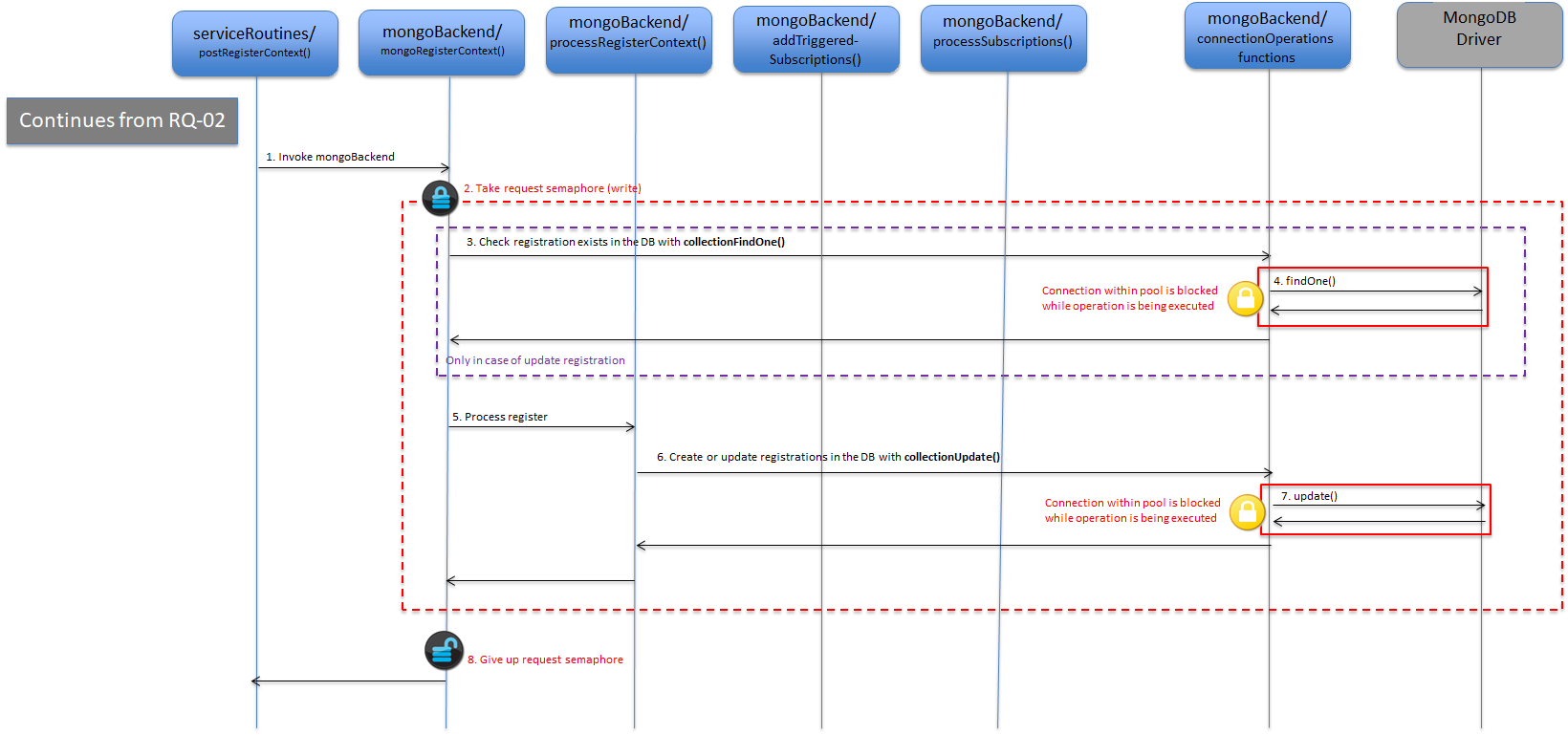
MB-18: mongoRegisterContext
mongoRegisterContext()is invoked from a service routine (step 1).- Depending on
-reqMutexPolicy, the request semaphore may be taken (write mode) (step 2). See this document for details. - In the case of
mongoRegisterContext()if a registration id was provided in the request, it indicates a registration update. Thus, theregistrationsdocument is retrieved from the database usingcollectionFindOne()in theconnectionOperationsmodule (steps 3 and 4). processRegisterContext()is called to process the registration (step 5).- The
registrationdocument is created or updated in the database. In order to do so,collectionUpdate()in theconnectionOperationsmodule is used, setting theupsertparameter totrue(steps 6 and 7). - If the request semaphore was taken in step 2, then it is released before returning (step 8).
mongoDiscoverContextAvailability (SR)
mongoDiscoverContextAvailability encapsulates the logic for the context availability discovery (NGSIv1) operation.
The header file contains only a function named mongoDiscoverContextAvailability() which uses a DiscoverContextAvailabilityRequest object as input parameter and a DiscoverContextAvailabilityResponse as output parameter. Its work is to build a response object based on the input request object and the registration existing in the database.
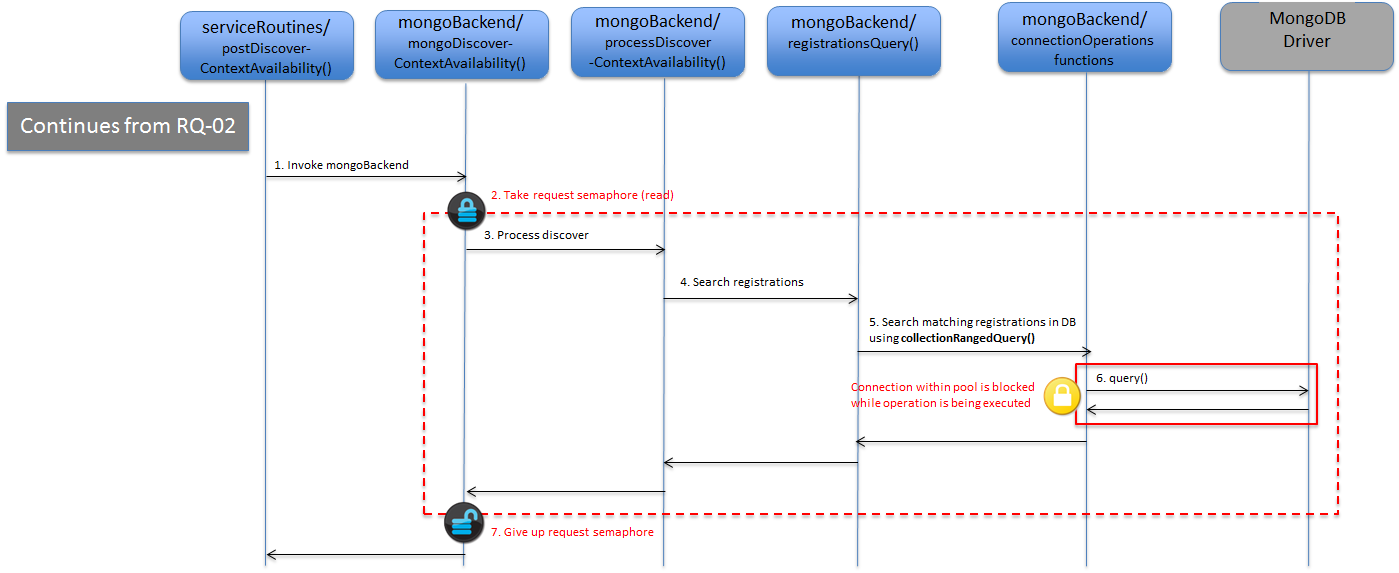
MB-19: mongoDiscoverContextAvailability
mongoDiscoverContextAvailability()is invoked from service routine (step 1)- Depending on
-reqMutexPolicy, the request semaphore may be taken (read mode) (step 2). See this document for details. - Execution flow passes to
processDiscoverContextAvailability()(step 3) - Registration search is done using
registrationQuery()(steps 4). This function in sequence usescollectionRangedQuery()in order to retrieve registrations from the database (steps 5 and 6). - If the request semaphore was taken in step 2, then it is released before returning (step 7).
mongoRegistrationGet (SR2)
mongoRegistrationGet encapsulates the logic for getting context registrations for NGSIv2 API.
The header file contains two functions:
mongoRegistrationGet(), to get individual context registrations by id, andmongoRegistrationsGet(), to get all context registrations.
They both return a Registration object (or a vector of Registration objects, in the case of get all) with the result.
In both cases, the implementation is based on a query on the registrations collection, (described as part of the database model in the administration documentation).
Regarding mongoRegistrationGet():
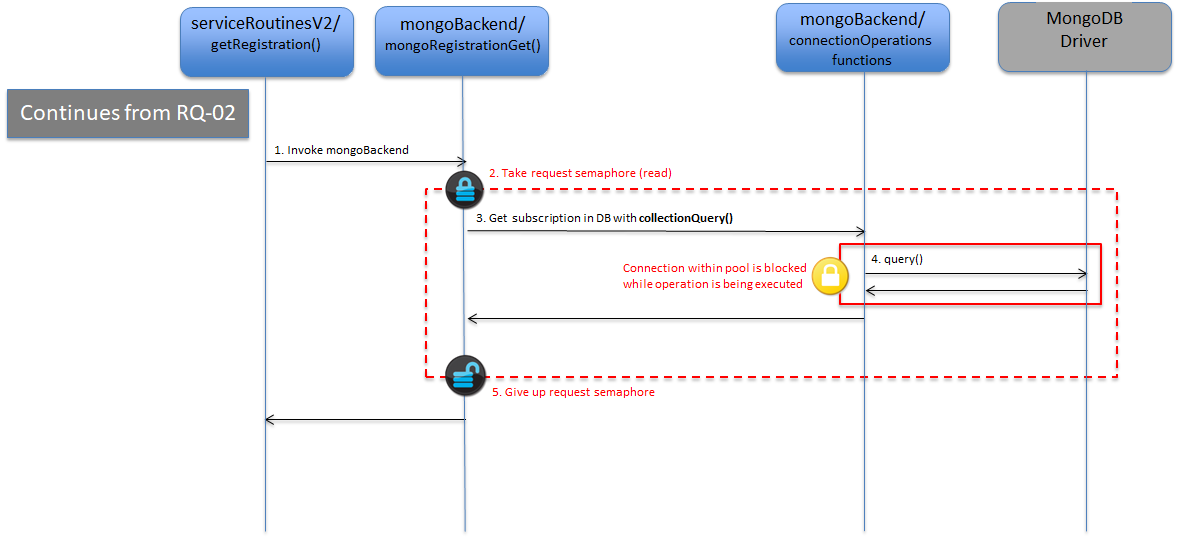
MB-23: mongoRegistrationGet
mongoRegistrationGet()is invoked from a service routine (step 1).- Depending on
-reqMutexPolicy, the request semaphore may be taken (read mode) (step 2). See this document for details. - The registration is retrieved from the database using
collectionQuery()in theconnectionOperationsmodule (steps 3 and 4). - Several
set*()functions are used in order to fill theRegistrationobject to return. - If the request semaphore was taken in step 2, then it is released before returning (step 5).
Regarding mongoRegistrationsGet():
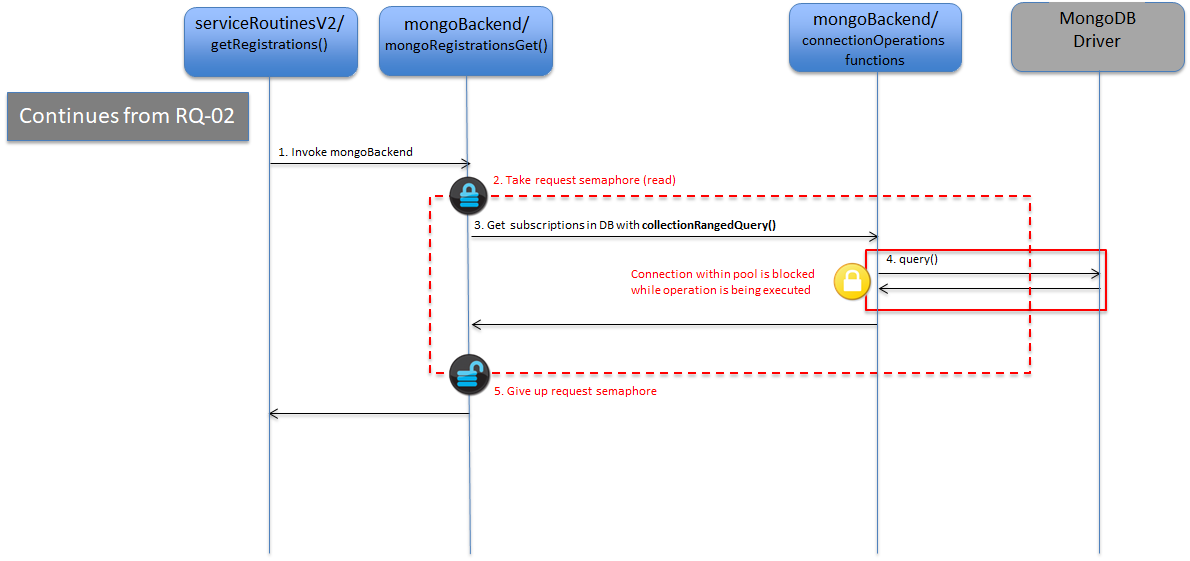
MB-24: mongoRegistrationsGet
mongoRegistrationsGet()is invoked from a service routine (step 1).- Depending on
-reqMutexPolicy, the request semaphore may be taken (read mode) (step 2). See this document for details. - The registration is retrieved from the database using
collectionRangedQuery()in theconnectionOperationsmodule (steps 3 and 4). - For each registration to return, several
set*()functions are used in order to fill theRegistrationobjects. - If the request semaphore was taken in step 2, then it is released before returning (step 6).
mongoRegistrationCreate (SR2)
mongoRegistrationCreate encapsulates the context registration creation logic for NGSIv2 API.
The header file contains only the function mongoRegistrationCreate() whose work is basically to get the information from a Registration object and to insert the corresponding document in the registrations collection in the database (described as part of the database model in the administration documentation).
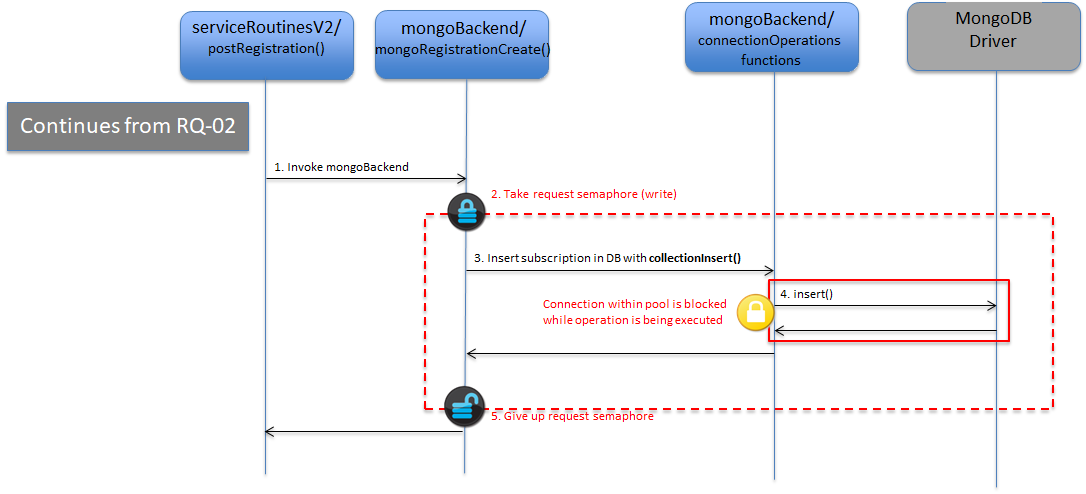
MB-25: mongoRegistrationCreate
mongoRegistrationCreate()is invoked from thepostRegistrations()service routine (step 1).- Depending on
-reqMutexPolicy, the request semaphore may be taken (write mode) (step 2). See this document for details. - This function builds a BSON object which in the end is the one to be persisted in the database, using different
set*()functions (setExpiration(),setRegistrationId(), etc.). The BSON object corresponding to the new registration is inserted into the database usingcollectionInsert()in theconnectionOperationsmodule (steps 3 and 4). - If the request semaphore was taken in step 2, then it is released before returning (step 5).
mongoRegistrationDelete (SR2)
mongoRegistrationDelete encapsulates the logic for removing registrations.
The header file contains only a function named mongoRegistrationDelete() which uses a registration ID (regId) as parameter.
Its work is to remove from the database the document associated to the registration in the registrations collection (described as part of the database model in the administration documentation).
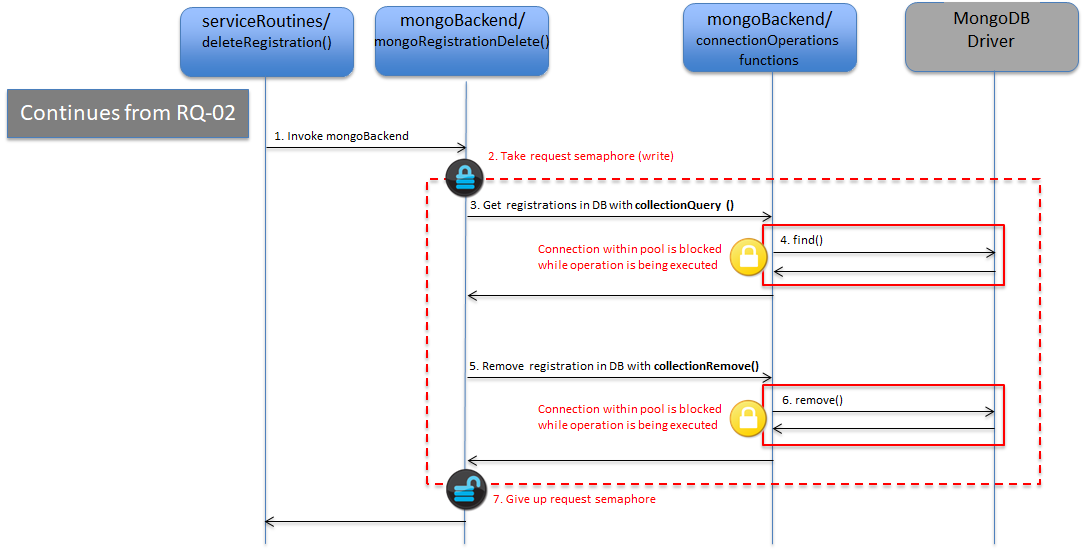
MB-27: mongoRegistrationDelete
mongoRegistrationDelete()is invoked from a service routine (step 1).- Depending on
-reqMutexPolicy, the request semaphore may be taken (write mode) (step 2). See this document for details. - The registration is retrieved from the database using
collectionQuery()in theconnectionOperationsmodule (steps 3 and 4). - The registration is removed from the database using
collectionRemove()in theconnectionOperationsmodule (steps 5 and 6). - If the request semaphore was taken in step 2, then it is released before returning (step 7).
Low-level modules related to database interaction
dbConstants(only.h): field names used at database level (the same as described in the database model documentation) are defined here.dbFieldsEncoding(only.h): inline helper functions to do encoding at database level and metadata string splitting.
Specific purpose modules
MongoCommonSubscription: common functions used by several other modules related to the subscription logic. Most of the functions of this module are set-functions to fill fields inSubscriptionsobjects.location: functions related to location management in the database.dateExpiration: functions related to TTL expiration date management in the database.mongoSubCache: functions used by the cache library to interact with the database.compoundResponsesandcompoundValueBson: modules that help in the conversion between BSON data and internal types (mainly in the ngsi library) and viceversa.TriggeredSubscription: helper class used by subscription logic (both context and context availability subscriptions) in order to encapsulate the information related to triggered subscriptions on context or registration creation/update.
The MongoGlobal module
Finally we have the MongoGlobal module, which contains a set of helper functions, used by other mongoBackend modules or even other libraries. It contains around 40 individual functions so it doesn't make sense to provide all the details in the present document. However, we will highlight the most important ones.
mongoInit()
mongoInit() is used by CB initialization logic (in contextBroker.cpp main()) to initialize the database connection pool.
entitiesQuery()
This function basically searches for entities in the database (entities collection, described as part of the database model in the administration documentation). It takes into account service (also named "tenant"), service path, pagination and sorting parameters. The query for MongoDB is composed of several parts: entities, service path, attributes and scopes (filters and geo-location).
entitiesQuery() relies on collectionRangedQuery() in the connectionOperations module in order to do the actual query in the database. After the query in the database, a part of the function annotates results in order to help in the Context Providers search done by the calling function, using the found attribute flag (see details in the source code). The result is then saved in a ContextElementResponseVector object, as output parameters.
The function is called from mongoQueryContext() (in the mongoQuery module), as the "core" of the query operation.
registrationsQuery()
This function basically searches for existing registrations in the (registrations collection, described as part of the database model in the administration documentation) of the database. It takes into account service (also named "tenant"), service path and pagination parameters.
It is used by several functions:
mongoDiscoverContextAvailability()(in themongoDiscoverContextAvailabilitymodule), as "core" of the discovery operation.mongoQueryContext()in themongoQueryContextmodule, in order to locate Context Providers for forwarding of the query. Note that the forwarding is not done within the mongoBackend library, but from the calling serviceRoutine.searchContextProviders()in theMongoCommonUpdatemodule, in order to locate Context Providers for forwarding of the update. Note that the forwarding is not done within the mongoBackend library, but from the calling serviceRoutine.